Olive Kitteridge: Overview

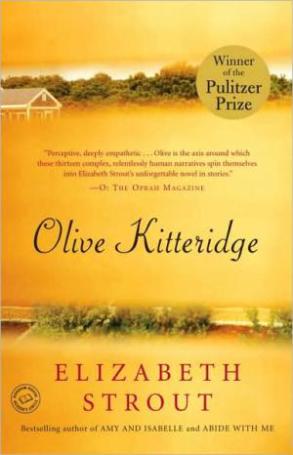
Nothing like a two-week jaunt, especially with a few transatlantic flights thrown it, to give you the chance to catch up on some reading. I polished off three books on my beautiful trip to France, the first being Even Cowgirls Get the Blues (which I talk about here). The second book I polished off is part of my Pulitzer journey: Elizabeth Strout’s Olive Kitteridge, winner of the 2009 literature prize.

Coincidentally, a few days after finishing it, I saw that a show of the same name was taking the Emmys by storm. I had no idea they had made it into a show. Has anyone seen it? Opinions? (And what’s up with them making a show from A Visit From the Goon Squad? I’m over here tapping my foot, staring at my watch…)

Anyway, if they keep to the book at all, it’s bound to be a wonderful show. Olive Kitteridge was a sober, minimalist book, but don’t let that keep you away. It’s excellent in every way.

Tl;dr Synopsis


Speaking of A Visit From the Goon Squad, Olive Kitteridge is hybrid novel and series of short stories in which every chapter is tied to the last one via characters, without strict regard to chronology or continuity. But that’s really where similarities between the two Pulitzer winners end.

Olive Kitteridge takes place in a small Maine town, focusing on the residents there. It’s a beautiful book full of snapshots. Each chapter is a snippet of a life. You’ll encounter recurring characters in the chapters, especially Olive herself; she is involved in some way in nearly all of the stories. You’ll, in some ways, follow Olive from middle age to her twilight years and watch how she deals with the disappointments of everyday life. (Hint: with grizzle.) In other ways, you’ll just watch pieces of the townsfolks’ lives pass you by. You’ll be plopped in the middle of their story and in some ways be left to wonder how they got to where they were before you met them and what will happen to them later. That information usually never comes, but Strout manages to make this lack of information okay by resolving each chapter in a satisfying way.

Strout captures the essence of a rural small town perfectly. This seems like a book set oddly in the past, as if the town is still stuck in the thirties even as it’s clear that at least some of the book takes place post-9/11. When teenagers Tim and Nina storm on the scene with their phones and parties and modern vernacular, it seems as if they are aliens from the future come to throw the book completely out of whack, which is exactly how I imagine every person in the Maine town would feel about such people. These are simple folks who live simple lives, and the appropriately simple writing emphasizes that. Yet Strout still deals with the complexity of the human experience–depression, disappointment, humiliation, and even sometimes joy–without short-changing it in Olive Kitteridge.

Writing Style

Olive Kitteridge, as I said above, is quite somber. It takes a bare-minimalist, Hemingway-like approach to writing that really works for Strout. (Can I say, too, how many wonderful women writers they’re awarding Pulitzers to?) The author does a great job of showing and not telling. Melissa Bank from NPR says it well when she says, “The writing is so perfect you don’t even notice it…it’s less like reading a story than experiencing it firsthand.”

A short example is from one of the times we first meet Olive. A couple is over for dinner, and the very sweet, somewhat dopey, and rather abused Henry Kitteridge knocks something over at the table and Olive berates him in a way that makes you cringe for the houseguests. Strout knows she doesn’t have to say anything about how awkward anyone there felt. You can just feel it from the events alone, and there’s the added bonus of starting to see what it’s like to be around Olive.

I think one of the key examples of the simplicity of the story is later on, on the day of Olive’s son’s wedding. Olive has made herself a dress from scratch for the occasion–a bright print dress that she’s very pleased with. She looks at it several times with pride. Then, later, when she’s tired and goes to her son’s bedroom to lie down, she overhears her new daughter-in-law and other girls talking about how embarrassed for Olive they were that she could wear the dress in public. The author doesn’t do what many other authors might: talk about Olive’s anger or her self-loathing or sadness, or even something as subtle as heat rising to Olive’s face. Instead, the author stays fairly far out of the narrative other than to describe Olive’s delicious act of taking a permanent marker, finding one of the daughter-in-law’s cream sweaters near the bottom of a folded pile, and putting a bold mark across it, and folding it back into the pile. That’s pretty much all you get, and it’s more than enough.

Olive Kitteridge deals head-on with a lot of tragedy and loneliness, but it’s written in the least sentimental way possible. It lends the book a rawness and authenticity that’s striking. This is a book that stays with you, and it doesn’t use any cheap tactics to burrow its way into your heart.

Characters

The sheer number of characters you meet is rather daunting. Check the Wikipedia list. I count 94. You only hear about many of them once, though, and there isn’t a lot of pressure to remember them or confusion when they come back into the picture. It’s your own, personal little Easter egg if you remember, for instance, that the Daisy who nurses anorexic Nina is the same Daisy that Henry Kitteridge greats at church in the beginning of the novel. It’s a lot like how you can watch a random Law and Order episode and it really doesn’t matter much if you’ve been keeping up with the personal lives of the detectives. (Unless, of course, it’s SVU, which has devolved into a bit of a soap opera. Today’s blog post is turning into “Amanda’s Thoughts: T.V. Edition.” I’ll try to get back on track.)

The characters are all individuals. No one is going to be confused with the other, and you get the feeling that all 94 of these people are fully-formed individuals that the author has fleshed out before writing the novel. It’s amazing.

The characters are not necessarily likable. They waver back and forth. I changed my mind every chapter about how I felt about the Kitteridges. Sometimes I thought Henry was so sweet, sometimes I thought he was an absolute idiot, then I would feel bad about that and think he was sweet again. It’s really a lot how real relationships go, with a kind of ebb and flow to how you feel about the person as both of you grow and change and have interactions.   

Highlights

You know, I found the first chapter to be a little jarring. There’s a serious feeling of being dropped out of a plane into the middle of a story, and you feel a little bit like someone may have torn out the first few pages of your book and you’re missing something. But looking back, I think the first chapter was my favorite. Olive sure isn’t cast in a good light in the beginning, but that first chapter is full of wonderful nostalgia and human connection and longing and remembrance. Oh, and you’ll learn more about Olive and feel for her later. The things she says in the beginning come from a place that you’ll understand, and you’ll be given the freedom to respect her, I think. See, I’m talking about these people like they’re real. They feel real.

Another highlight is all the chapters that portray people in love. Look for the chapter on Daisy and Harmon, for instance. There’s some sadness in it, but I mostly think it’s a beautifully hopeful chapter. There aren’t many of those, but the ones that exist are an experience akin to stuffing your face with Noodles & Co.’s mac and cheese. They feel indulgent and comforting. The book closes on that kind of note, and it’s pretty great.

Who Should Read this Book

I hate to say this because this book really is a masterpiece. But I don’t think it’s for everyone. It’s heavy. There are few moments of happiness in Olive Kitteridge, and the ones that exist are tinged with something undefinable that makes your heart ache. I think this is undercover one of the saddest books I’ve ever read. I say undercover because it isn’t like the reader’s constantly dealing with death after death after brutal heartbreak, etc. Olive Kitteridge mostly just deals with insidious disappointments that quietly accumulate day by day. When faced with it like this, in digestible book format, forced to acknowledge it over a few sittings, it’s hard not to feel like life itself isn’t something quite sad altogether.

So. If you’re a beach-reader who prefers lighthearted stuff and mainly uses books as a happy escape (no judgement here on that), this book might not be for you.

But if you’re okay with heavier stuff, it’s worth it to experience the craft of this book. The writing is executed in a way that stuns me. Strout does everything right. If I were teaching creative writing, which I am utterly unqualified to do, this book would be on my required reading list. It’s an example of writing at its best. And, despite the sadness, I really loved reading it. The book is gorgeous.

For What It’s Worth (A.K.A. My Opinion)

Wow, I think I already got it all out of my system.

If you can, you should at least try to read this. The writing stands in a category by itself, and the stories are gripping. It’s an experience that I think you should have, if it suits you.
 

Even Cowgirls Get the Blues: Overview

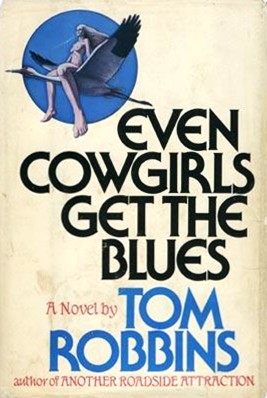
EvenCowgirlsGetTheBlues(1stEd)Have you ever read Thomas Pynchon and thought, “Man. This would be pretty awesome stuff if I could even begin to grasp what on earth he’s talking about”?

If so, Tom Robbins’ Even Cowgirls Get the Blues may be for you.  For all its postmodern whimsy, it’s an actual book with an actual, accessible plot. It’s charming when it’s not being absolutely ridiculous. But then again, ridiculousness is part of its charm to some, I’ll wager.

Tl;dr Synopsis

Sissy, our protagonist, has huge thumbs. I’m not sure if there’s a figurative meaning for that, but if there is, I don’t mean it figuratively. I mean the thumbs on her hand are huge.

She hitchhikes with them. She has a lot of thoughts. The author also has a lot of thoughts.

Sissy’s travels take her to an all-girl ranch, run by Bonanza Jellybean, that is nearly utopia.  Everything in the novel hinges on this place. Even when Sissy leaves shortly after arriving, her heart stays there.

Interesting miscellany ensues. Endangered birds are fed peyote. There is folklore around something called the clockworks, which is difficult to describe, especially since I don’t understand it. A pervy old would-be philosopher on a hill spouts cryptic tidbits of what’s either spiritual knowledge or nonsense. The author interjects himself for a chapter and then scolds himself for interrupting the story.

But it all winds up coming to this: when the world conspires to take the all-girl ranch from the posse, they fight for it. I won’t spoil the ending from there.

Writing Style

Quirktastic. Absolutely off the wall. The beginning of the book is a chapter on amoebas. His style is juicy and visceral, full of colors and joyus screams. You also don’t know what each chapter may bring. At one point, there’s a subchapter: 111a, to be precise. It concludes with “DANGER: RADIATION. Unauthorized personnel not allowed on the premises of chapter 111a.”

Robbins is creative writing at its most creative, and his writing style is postmodern (or “po-mo,” if you’re an insufferable M.F.A. candidate) as can be. The content is a different story–Robbins takes himself quite seriously in many cases. But as far as style goes, he is just as I said before–an accessible Pynchon. He manages to weave an actual, interesting, followable plot in the midst of his zaniness.

Characters

Ah, but here’s the gripe. Normally when I find characters to be the fault of a novel, it’s because they’re trite, cliche, or otherwise unremarkable. Here, they’re all remarkable. That’s because they’re all the author.

It didn’t start out that way. Sissy was unique in the beginning. The Countess is fantastically unique (at least before he gets his marbles rattled). And Bonanza Jellybean, bless her literary figure’s heart, remains unique until the end. But almost all the rest of the characters–Sissy, Dr. Robbins, the Chink (that’s his name, for real)–they all become one voice. One philosophical, cooky, offbeat voice, but one voice nonetheless. It’s like reading an Ayn Rand book. You get the feeling that all characters are just vehicles for the author to speak, as himself.

Some of the girls at the ranch are different from the author. But they aren’t unique. They are archetypes representing different schools of feminism, with Delores Del Ruby being the radical separatist and Debbie being the cultural feminist.  And frankly, they turn into the author at the end, too.

But, oh, my Jellybean. In all her simplicity, she is separate from the author and free of roles. All she wants, and all she’s ever wanted, is to be a cowgirl. And her belief that all people should be able to be whatever they were meant to be, that pure simplicity, makes her the most endearing.

But before I leave the characters section, one note. It’s interesting that who I can only assume is meant to be the villain of the novel, the feminine hygiene magistrate Countess, is one of the best characters in the book. Robbins, who to his credit has written a fantastically girl-centered, girl-empowered, feel-good book, clearly does not identify with the one in his book characterized by his hatred of women. So he separates his voice out from the character and just writes an awesome, funny, unusual, despicable character with prissy tastes and raunchy but to-the-point conversation.

My thoughts? Robbins, over the course of writing the book, fell too in love with some of his characters. He and his characters all started to meld together until no one was distinguishable.

Highlights

“It was about two minutes on the tequila side of sunrise.”

What a great line.

Also, enjoy your time at the ranch, readers. It’s a great place to be. The scenes at the ranch are the best parts of the book, and you will feel as hollow as Sissy did when you have to leave.

I should mention, too–the fun of this book is a highlight. It’s serious at times, but for the most part, it’s an enjoyable, light pleasure cruise of a read without being mindless. It’s like watching a coloring book be filled in with a crazy genius holding the crayons.

Who Should Read this Book

You have to like the off-color and some raunch to enjoy this book. You also have to have a special love of language for its own sake, I think. There are a lot of meandering chapters. But for the most part, this is a really delightful book, and its accessibility is appreciated, considering the genre.

For What It’s Worth (A.K.A. My Opinion)

I had a good time reading this. It put a smile on my face. But it wasn’t all sunshine for me as a reader.

You got the first glimpse into my issue when I discussed the characters. And you may recall that I said the style was postmodern, but the content was not. That’s because the content wasn’t flippant about reason and purpose and deep thought–in fact, it was all up in those things. And that’s the exhausting part, for me. The philosophizing and deep-for-the-sake-of-deep was tiresome, and the characters just wound up being the mouthpiece for the author’s ideas in the end. It’s a little hard to take. Sissy’s thumbs, for instance–you got the feeling there was supposed to be symbolism in there about her being especially evolved (you know, opposable thumb times ten or something), but you also got the feeling it was never really fleshed out in the author’s head. He was just going to throw it out there, and people who got him would get it. Okay, that’s fine. But it’s not exactly brilliant writing.

And there’s more. There’s a huge spiel about how everything in nature is a circle and there’s all the philosophy about time and clocks, and frankly, none of it feels like it was well thought out. It really is like reading Ayn Rand sometimes. “I’m a philosopher! I have big thoughts! Check out these vague and undeveloped big thoughts!” When conversation after conversation goes on like this in the book, I kind of wanted to skip ahead.

But those are harsh words for a book that I enjoyed a lot. I won’t say I’ve never read anything like it, but many readers probably haven’t, and I don’t think I’ve read anything in the genre that was this fun. This is a great avant garde starter book.


Hate on Franzen. Go Ahead.

But portray the dysfunction of human relationships like he did in The Corrections. I dare you. 

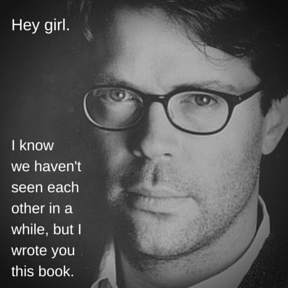
Hey girl.

Anyway. I am EXCITED.

So, if you rely on me for your literary news, (1) I’m sorry, and (2) Jonathan Franzen is coming out with a book named Purity in September. All the world is abuzz with Franzen hate right now, and I’m sorry–I just can’t comprehend it. The main accusation? “His booksexes be all, you know, not sexy and stuff.”

You people. The essence of the sex in his books is that it’s awkward. It’s one of the many things that makes the relationships in his book so believable and so human. So you want perfectly natural scenes of seduction where two fabulously attractive people with great communication skills and no mommy/daddy issues feel free to ask each other to fulfill their deepest desires, fall naturally into perfect sync and find utter satisfaction with one another? End scene; light cigarette? Well. The erotic fiction department of Amazon is thriving, and you, too, can donate your crisp dollars to the cause.

Franzen’s writing reminds me of Dostoyevsky’s Notes from the Underground. We have a character that’s terribly awkward and struggling to connect with others while being cripplingly self-conscious and selfishly single-minded in his pursuit of ephemeral satisfactions–all the while being in terrible psychic distress–these are Franzen’s characters. Faulty. Awkward. Selfish. Bad decision makers. Above all, human.

I cannot WAIT for the new novel. Naysayers, I am glad you found some titillating thing of his to pick on, just to go against the grain. And you may even have a point. But for all the accusations of being a literary priss, I love me some Franzen. I can’t wait for Purity.

Note: If you haven’t picked up a Franzen book, skip Freedom for the time being and pick up his The Corrections. You will find someone you know in there–someone you could likely write your own book about. Everyone has a mother, father, sister, brother, or significant other that is in this book. I promise. Plus, the storyline and the characters are just better–more fascinating, less frustrating.

Couple posts brewing in the background, but, you know, life. I’ll get there soon. Thanks for tuning in and HAPPY FRANZEN READING!

Reading a Boatload of Karen Russell

I have been a terrible blogger, and for that, I apologize. It isn’t as though I haven’t been reading. I’ve just been too full of thoughts and without enough discipline to sit down and write about them.

I’ve been binging on Karen Russell. I read Swamplandia!, and, in quick summary, it’s about a family that runs a failing alligator-themed tourist trap in the Everglades. It’s a great premise, and there are good things about the book. However–and I hate to say it–I kind of understand why the Pulitzer crew just couldn’t hand it over to her. The book isn’t as good as her shorter stories. It’s missing the magic balance between fantasy and reality that makes her writing so enchanting. And there’s something near the end of Swamplandia! that feels like a cheap move, story-wise. Actually, there are a few things that feel cheap. There wasn’t any building toward a crescendo, and the plot often felt like it was just drifting without much authorial control. I remember being halfway through and just shaking my head, thinking, “Where is this going?” There’s a sense at the end that the book was ending because Russell was like, “Well, got to end this somewhere,” and I feel like there were some shoddy tactics to force a surge at the end that isn’t fair to the reader or to Russell. I feel the most sad about the latter being cheated because Russell is an amazing writer, and she deserved for a better work to be considered her piece of note.

Sleep Donation was so much better. It was much shorter, and the premise was fascinating. A disease has taken hold of the world, and it makes it so that people can’t sleep. It’s at epidemic proportions when we come into the story. People are dying of sleep deprivation. But they have something that eases the suffering of insomniacs, and even in some cases cures them. That thing is sleep donations from healthy sleepers. The protagonist of this book works for a sleep donation collection agency, and her job is to convince healthy people to donate their sleep. I won’t give away the rest of the story. It was not as imaginative and fantasy-based as her short story collections but it’s quite good and easy to put away. I read it on a plane ride from Chicago to San Antonio.

Now I’m cruising through Vampires in the Lemon Grove. Oh my. Short stories are really where Russell shines. These are so amazing and creative, with the same kind of balance between the human and the fantastic that made St. Lucy’s Home for Girls Raised by Wolves so great. There’s a particular story in here called “Reeling for the Empire” that is the kind of haunting that sticks with you. In it, little girls are turned into human/silkworm hybrids and forced to slave every day for their food. It ends in a way so utterly satisfying that you want jump up and do a victory fist pump.

More later. Just wanted to check in. It isn’t my goal to become a book reviewer; I prefer doing the analytical posts by far. But if I don’t write down some things on what I’m reading, the obsessive in me will tell me I can’t blog about anything new until I cover everything I read. One of these days I’m going to feed my obsessive to one of Russell’s alligators.

Tinkers: Overview

I love diving deep into books and focusing on specifics like motifs, character development, and author technique. But after a bit of feedback from a fellow blogger, I realized that I may be alienating readers a bit (who, of course, won’t have the exact same reading itinerary as me) with these posts. So I figure that, in addition to my more in-depth examinations, I’ll do an introductory overview post for each book I read that caters to those who haven’t read it.

So here it is: an intro to 2010’s Pulitzer The Tinkers by Paul Harding. (I skipped 2011’s A Visit From the Goon Squad because I’ve already read it. If you haven’t, go buy it right now. It’s absolutely spectacular.)

Tl;dr Synopsis

An old man is sick and dying in his house. His father was a rural merchant who sold things out of a cart. It alternates rather rapidly back and forth (every few pages) between the son’s last moments and stories from his father’s life. The two stories don’t really intertwine until the end. It’s a fairly quick read and can be tackled in hours rather than days.

Writing Style

Harding has a Dickens-meets-fantasy style with long, rolling sentences that meander from the fantastic to the curt and realistic. Fans of the prose will call it poetic, deep, and imaginative. Critics will call the prose long-winded and claim that any creativity found inside has been far too diluted by the word count to have any potency. Here’s a sentence typical of the book:

“Cold hopped onto the tips of his toes and rode on the ripples of the ringing throughout his body until his teeth clattered and his knees faltered and he had to hug himself to keep from unraveling.”

Characters

The son is sick and nervous about dying. He turns out to be a bit of a swindler. He works on clocks. Yep…that’s about it for him. His father is epileptic and a dreamer, kind but unpredictable. He makes a living (barely) by toting around a cart and selling sundries to countryfolk. We get to know him a little better than his son, but not by much.

Highlights

At one point, the dying son thinks the ceiling, roof, clouds, sky, and whole universe is falling on him, one by one. It’s surreal and imaginative, and it’s very well done.

There’s also a charming dynamic between the merchant father and a hermit. They only meet briefly in the book, but the section that detailed their interaction was the part I remember most fondly.

Who Should Read this Book

This is a solemn, slow-moving book with a lot of abstraction. Harding thinks nothing of making use of four or five coordinating conjunctions in a sentence, and he thinks nothing of making a sentence an entire paragraph. He also experiments with short, Hemmingway-like descriptions in the passages that describe the father’s life, but he eventually throws that experiment in simplicity by the wayside. This is a book that is attempting to be high art, and if you’re looking for plot or easy reading, this is not your book. This book is more longform poetry than novel. So if you love poetry, this might be your jam.

For What It’s Worth (A.K.A. My Opinion)

Certainly, the novel has some imaginative parts, but they almost always fall flat. This book, to me, has all the flavor of a communion wafer. It’s sterile. Most who know my taste would probably imagine I’d love Harding’s flowering, abstract style of prose. I’m not 100% sure where this went wrong.

I think I’m getting an “art for art’s sake” vibe coming off this book, and the “art” of his prose just doesn’t cut it–in fact, most of his passages don’t work at all. His description and metaphor have the ring of a student in a fine arts grad program trying to find the ground under him. He’s struggling to be deep and haunting, but he’s just creating passages that don’t make any sense and aren’t poignant in the slightest. Here’s an example of this:

“When his grandchildren had been little, they had asked if they could hide inside [his grandfather clock]. Now he wanted to gather them and open himself up and hide them among his ribs and faintly ticking heart.”

Uh.

Or how about this? In the story, the son’s leg muscles stiffened as he got closer to death, spawning this passage from Harding:

“When his wife touched his legs at night in bed, through his pajamas, she thought of oak or maple and had to make herself think of something else in order not to imagine going down to his workshop in the basement and getting sandpaper and stain and sanding his legs and staining them with a brush, as if they belonged to a piece of furniture.”

What.

This sort of passage just doesn’t work. It isn’t just that his wife (nor anyone, for that matter) would actually think of that. It also doesn’t add anything to the story. It’s just words and imagery for their own sake, and that imagery isn’t good enough to stand alone as art. The problem with empty, nonsensical passages is that you run the risk of losing your audience. When your words aren’t worth much, people will start scanning.There isn’t enough reward to justify the work of reading.

This isn’t so much the case in the beginning–it’s easy enough to follow the cadence of present/deathbed to past/father’s life to present/deathbed. But then things start switching from third person to first person and back again. It reminds me of the end of Beloved, except the confusion caused there by the switching from person to person and viewpoint to viewpoint reflects the madness that’s taken over the house, blurring the lines between individual delineations. In Tinkers, it just seems like Harding is trying to be experimental without much of any direction.

I’d be interested to hear from anyone who disagrees with this assessment. I’m easily swayed. Meanwhile, if you haven’t read the book, there’s your essentials plus my bonus peanut gallery comments. Hopefully readers can feel a little more included in the conversation if I pop off posts like these when I finish a book.

Did you know 2012 didn’t have a Pulitzer winner? One of the books in the running was Swamplandia by Karen Russell. Since I happen to have bought her St. Lucy’s Home for Girls Raised by Wolves on recommendation from a former professor, I think I’ll read that as my stand-in for 2012. Yes, I just read 2010’s and I’m totally out of order. Yes, that isn’t even the Russell book that was nominated. I’m a free spirit.

The Orphan Master’s Son…Not Sure I Can Make It

I’m 10% into Adam Johnson’s The Orphan Master’s Son. I’m not sure if I can take it much longer.

It’s a good book. It’s next on my list — the 2013 Pulitzer winner. It’s matter-of-fact. It’s Orwellian.  It’s easy to read, despite the vastly different cultures being portrayed. In fact, the culture is so amazingly, authentically, vastly different, it’s awkward to read in English. (Though the primary text is presumably written in English, I, like the writer of this Guardian review, assumed the author simply had to be Korean. But the author is an American that teaches at Stanford. The authenticity is incredible, at least to my ignorant, American eyes.)

The problem isn’t the quality of the writing or the story. It’s just too awful for me right now. There are horrible injustices and human violation rights perpetrated, even ten percent in. Ten percent. I don’t know if I can take the ninety percent more that’s in store for me. And you know what’s funny? It isn’t the human rights violations that made me put the book down and write this. It’s the sharks. The poor, poor sharks. Let’s just say they’re being abused and I cannot, cannot, CANNOT deal with animals being hurt.

The sharks were just icing on the “nooo, I can’t deal” cake, though. I googled a bit to see if I could look forward to more bearable material further in, and I see some developments in character are fleshed out later in the book. I’d look forward to reading about that. There’s an empathy and weakness for love in the main character that’s so far only been hinted at. More of this comes later. It also sounds like there is an attempt to escape this cultural prison, and I’d look forward to that as well. But I also read some quoted passages in reviews, and it warns me about going forward. I haven’t hit the worst of it, and frankly, I don’t really want to. It’s already so very, very awful.

This book reminds me quite a lot of Slaughterhouse 5. It’s got a matter-of-fact way of dealing with horrors that the human psyche simply can’t handle without shutting down, to some degree. That’s authentic, and it’s good writing. But man. I don’t know. It isn’t easy to handle, if you’re an empath.

The Goldfinch in the Age of Mechanical Reproduction (+ Final Thoughts)

Mauritshuis_Fabritius_605

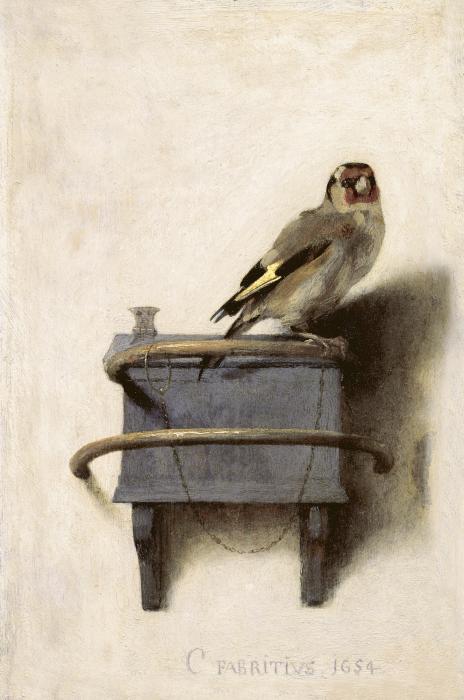
Here it is: Fabritius’ goldfinch. Funny. After reading this book twice now, I imagined that the picture would have a eerie kind of bioluminescence–a living glow that would flow through the rectangle in Google images, bounce around some rods and cones and register in my brain as a masterpiece so bright these mortal eyes should be averted. (Also, was I wrong to think the goldfinch would be bright yellow?)

But maybe the reason it doesn’t have that effect was because Google handed me a screen that looked like this:

Capture

Professional deep thinker Walter Benjamin wrote a rather dense piece called “The Work of Art in the Age of Mechanical Reproduction” in the 1930s. It explores the role of art in an era capable of producing film, photography, and — most interestingly (to me) — machine copies. He posited that a work of art has an aura, and that that aura is based in its uniqueness. Therefore, every time a student puts up a poster of The Persistence of Memory in their dorm or every time someone sips coffee out of a mug imprinted with Monet’s lilies, the original’s aura is depleted.

Benjamin isn’t saying this is necessarily bad, and there’s a lot more to the essay — most of which I’m too obtuse to really wrap my head around, even after reading it several times. But seeing all these reproductions on my computer screen…is that what takes the magic out of the painting? Not according to Tartt’s The Goldfinch.

I was struck by how many twists on Benjamin’s essay come rolling in at the end of The Goldfinch (novel). When Theo is in the Netherlands, escaping from the scene of a heist-on-heist, he knows that the painting is authentic the moment he looks at it during the car ride to Amsterdam. It glows with an ethereal light he knows so well. The entire book seems to imply that The Goldfinch (painting) has a soul inside it, defying all of Benjamin’s claims that a painting’s aura is depleted in an age of mechanical reproduction. Surely the painting has been photographed thousands of times, as indicated by my Google image search. In Tartt’s book, Theo sees reproductions of the painting in art books, newspapers, and even a photograph of Welty in a room with a counterfeit. (Which, by the way, is an image of an image of an image of an image. The last image is the bird itself. Intense.)  Yet the soul of the thing doesn’t seem the least bit damaged by all its reproductions, at least not to Theo.

Even the painting is a reproduction, as Theo knows. He has no doubt that the artist had a live subject, and Boris mentions his certainty that, in a cage full of goldfinches, he could point out with ease the goldfinch. Theo and Boris both seem to believe that they know the bird, as presumably do the many others bewitched by the painting: Welty, Theo’s mother, Lucius Reeve. And yet, at the end, Theo comments that the painting is a trick, a “joke” — these globs of paint and scratches into the canvas and brushstrokes that, as you stand back, transform from what is really just deposited paint into a very convincing representation of a bird. One might point to the painting and say, “It’s a bird,” though really all the viewer is seeing is patterns of paint.

How can this reproduction not be a thing that takes from the soul of the bird? How can the painting have a aura its own, if Benjamin is correct?

Theo even sees the glow of the painting in a forgery, placed on a wall in an old photograph of Welty as a child. It’s difficult to get further away from the original goldfinch (or original goldfinch painting, even) than this image four times removed. But Hobie, the book’s good-hearted creator of forgeries that he never intends to sell, has an answer for Theo. He guesses that it isn’t the originality or uniqueness of art, as Benjamin suggests, that gives art its aura. It’s the beauty of line. If there is a particularly beautiful shape, it doesn’t matter if the object is reproduced or original. That’s why his lovingly created reproductions of antique furniture were so charming — he was reproducing a thing that had beauty, and he was able to preserve the thing that made it beautiful. It seems that Hobie doesn’t buy into Benjamin’s theory at all. But both believe that the original goldfinch painting in itself would lack the mystic quality Theo assigns it.

If Hobie or Benjamin speak true on the subject of the original piece of art lacking a soul–in Hobie’s mind, because it’s the beautiful image of the goldfinch, not the object that is the painting, that’s important; in Benjamin’s mind, because the painting has been reproduced enough to have had its soul depleted)–why is it that Theo so passionately felt that if The Goldfinch (the painting) was destroyed, the world would have lost something important? Why was it so necessary that what he held in his hand was the real thing on the way back to hotel in Amsterdam? I don’t have an answer for this, and I certainly don’t think the novel does, either. And, on another subject, that might be one of my few complaints about the book.

I connect so wholeheartedly to this novel. Just about every page of The Goldfinch absorbs me fully. But there is a lot of incoherence in it. That’d normally be fine with me; life is rather incoherent. But it seemed so important to Tartt, especially at the end, to become some sort of lecturer/philosopher. You have to have a special kind of brain for that. A Walter Benjamin brain. One capable of working out a theory, however crazy, to a certain level of completeness. A brain that can reach beyond bland platitudes and reach a hypothesis that, for instance, isn’t so broad that it can’t be wrong. Tartt is a glorious, deep feeling, intelligent author, but she doesn’t have that brain.

The end of The Goldfinch could have saved if Tartt stayed in-novel. The parts where Boris and Hobie sit down and start talking about “You know, maybe bad deeds can result in something good” is pretty cheesy in a folksy, from-the-mouths-of babes, “Well, little ‘ol me don’t know much about ____, but I’s been thinking…” type of way. But it was tolerable. The whole meta-lecture from Theo at the end, on the other hand, (which goes on for pages and pages) is insufferable. I just went tearing through it the first time, since it was two in the morning and I could see I was close to finished. But this time I sat through every word, focused. It isn’t horrible writing, but it’s patronizing, and it takes you waaaaaay out of the novel to treat you to some “big thought,” stoner ending. The end of the book meant well–it meant to bring us closure after all these pages filled with Theo’s ongoing, unspeakable sadness. But it was reminiscent of–horror of all horrors–John Galt’s speech (a.k.a. Ayn Rand’s excuse to bluster incoherently about her personal world view for a sickening number of pages) in Atlas Shrugged.

Ending aside, I remain firm after my second reading.  The Goldfinch is a spectacular book, full of aching feelings and beautiful intricacies. It contains endless starting points for conversation with others, but it will at the same time be a deeply personal experience for the reader to have. It brought to my mind many philosophies of which I’ve read–not just those of Benjamin, but also those of aesthetes and critics from many fields and varied time periods. It’s a great introduction to ways of thinking about art. as well as to good literature.

Theo’s Spiritual Connection to Objects in The Goldfinch

To lift one of my favorite introductions (Simon Jarvis, from an essay in PMLA), “Reader! No time for pleasantries!”

It’s easy to assume Theo is attached to the goldfinch painting because it’s his last connection to his mother. And that may be so. But I think there’s more there.

I’m really struggling for a word here–totemism comes to mind, but it’s not exactly right. It might do for our purposes here though, if you’ll allow for some flexibility. Totems are symbols of one’s spiritual connections to things of the earth. The term is mostly used in reference to animals. But here, Theo connects to manmade objects the way tribes have connected to a specific creature or element. His goldfinch painting is the most obvious example–and it isn’t the animal he connects with as much as it is the painting. He feels differently with it around, looking at it, holding it. He obsesses over the weight and feel of it, and he feels as if it glows in a way that’s almost unearthly. But he does this with other things, too, starting from a very young age. About Welty’s ring, he says this:

For reasons I would have found hard to explain, I had taken to carrying the old man’s ring with me almost everywhere I went. Mostly I toyed around with it while it was in my jacket pocket…I ignored [Mrs. Barbor’s] advice to put it in a safe place, and continued to carry it around in my pocket. When I hefted it in my palm, it was very heavy; if I closed my fingers around it, the gold got warm from the heat of my hand but the carved stone stayed cool. Its weighty, antiquated quality, its mixture of sobriety and brightness, were strangely comforting; if I fixed my attention on it intensely enough, it had a strange power to anchor me in my drifting state and shut out the world around me…

And Theo, especially after his trauma, continues to find objects, not people, his anchor. He feels utterly lost when he realizes he no longer has access to his painting. He immerses himself in the touch and feel of the furniture he works on with Hobie. Certainly he finds solace in a few people here and there, but what he finds the deepest connections with are not people, but things.

There is one exception. The way he describes Pippa in the book is very similar to the way he describes the objects he attaches to. He notes her attributes, like her hair and clothing, with the same sort of fetishism with which he describes his totems. I wouldn’t probably go as far as to say Theo sees her as an object. In fact, I think part of what draws him to Pippa is the fact that he cannot possess her like he can an object. Theo’s a deep-feeling, intensely spiritual person, even from childhood, so it makes sense that he doesn’t objectify people quite in the context that we’d usually use the term.

He does not always know why he experiences the attachments he does–he just records his feelings and leaves them unsorted and unanalysed. I find it understandable, this reluctance to wonder too hard about the reasons behind his emotions. I don’t quite think of him as psychologically insightful, but that’s one of the great things about this character and about the book. It allows the reader to do the psychological work.

Theo in some ways reminds me of a character from a book I haven’t read in a long time: Joyce’s A Portrait of the Artist as a Young Man. Theo is an aesthetician (an old-school one, not the kind you find at the Clinique counter), but there’s a desperate quality to his appreciation of beauty. When he learns that people can be lost, he connects instead with objects. Then, when he realizes objects can also be lost even when the greatest care is taken to preserve them, well, that’s pretty rough.

The Goldfinch: Also…

There are a lot of negative reviews of The Goldfinch out there from those who find contrarian delights in raging against the literary machine. There are accusations of juvenility and uninventive language. Props to them for their reluctance to accept a well-acclaimed book simply because it is well-acclaimed, but in this case, they’re just bitter. The book makes us take a juvenile seriously, and any moments of cliche (“tip of the iceberg,” for example) add an element of conversation and authenticity.

Take this as a clearly biased report from Camp Goldfinch. “Think for yourself; question authority,” as the great band Tool advises, but read the book. You’ll decide.

Here is a much better synopsis than my own from the New York TImes‘ Book Review.

The Goldfinch: All it’s Cracked Up to Be

As a loud and proud feminist, this is the worst thing I will ever say. (Yes, leave it to me to think of the worst thing I will ever say and then immediately put it on the internet.) I finished The Goldfinch before even looking to see who the author was, and I was shocked to learn it was written by a female.

I had a discussion with a very forward-thinking teacher once about why I don’t like female writers as much as male ones, historically. He, too, very much resented himself for feeling like male authors seemed to create more depth in their work. But, as ashamed as it made us, it just seemed true. There are glowing exceptions, of course (Eliot, Chopin, the Brontes), but even they seemed to have heteronormative-relationship-driven plots, with romance being at least one of the major (if not the) key theme. In fact, I think this is why I resented Anna Karenina. It seemed to me a very “female author” book–all about man-woman pairings and dynamics. I think about Whitman’s claim that he contained multitudes, and it seems to be the anti-anthem of the novelists I don’t like (who, unfortunately, often tend to be women). “I contain the potential for romance” seems to be the driving force behind it all.

We have been and are entering a new era of women writers. I don’t know why, after reading books from Jennifer Egan and Toni Morrison, I still have lower expectations. But The Goldfinch solidifies it. This is a deep and rich book that explores so many facets of human existence, with an absolutely riveting plot the whole way through. It’s multidimensional and complex psychologically while carrying with it a story that captivates. The climax of the book went on forever, and I got four hours of sleep one night because I couldn’t put it down. In fact, this whole enormous book was enrapturing the entire way through. In fact (x 2), the reason I haven’t posted about it yet is because I accidentally started reading the whole thing again. I couldn’t help myself. I wanted to be back in this world of multitudes.

Have you heard anything about the book? There was a lot of hype around it. Let me say, the Pulitzer will not lead you astray here. Every bit of the hype is well-founded. I can’t say enough about how good this book is. It’s the realest, freshest thing I’ve read since…oh…well, since Crime and Punishment. But still…

First off, this book even the sentence level is fresh. You know what’s really hard to do without entering cliche-land? Similes. Try writing a simile that doesn’t sound like bad poetry. Do it, right now. I’ll wait.

It was bad, wasn’t it?

This book is filled with similes that are gorgeous and vibrant and don’t stick out as similes. Here is where I would put examples, but I’ll just make that another post if need be. This sucker’s gonna be long enough.

Second of all, the book paints so many beautiful portraits of people, and it does so by showing, not telling. The main character is a prime example of this.We get to know him so well, and yet we don’t even understand what the goldfinch painting held so dear by the narrator means to him. Not even he knows, really. It just does, for reasons seemingly obvious but that will escape articulation if we try to explain it. Again, deserves an entire post in itself. Every one of the characters is complex and yet understandable, even the bit players like Tom Cable.

Third, author Donna Tartt does the passage of time so amazingly well. There is an “eight years later” jump at one point, but I think it helps character development. All of a sudden, our poor hero is in an unexpected place, and we learn how he got there. It all makes perfect sense, yet it’s surprising. The most amazing example of the passage of time is the way the author explains the development of what winds up being the extremely close friendship between the main character and Boris in Las Vegas. It develops naturally and beautifully. Speaking as someone who has a friendship very much like the one described in the book, the coverage of the time was so natural and the closeness that developed made so much sense. It all rang authentic in my mind. That, like the non-cliched simile, is very, very hard to pull off.

But my main takeaway from this book is that, even though the world of The Goldfinch is a fairly sad one, it’s a place I love to be. It envelops me. It rings true and real and beautiful. It’s heartbreaking without being sentimental, and it’s raw without being dramatic.The Goldfinch doesn’t pull any punches. It’s as complicated and involving as it is without gimmicks.

Clearly, this is a vague overview. I haven’t really said much of anything about the book. This is a real challenge for me to write about because it’s like someone asking me to try to describe my existence on this planet in a blog post. I’d just be left dumbfounded. There’s too much, far too much. The Goldfinch contains multitudes, and all we can hope to do it examine it piece by piece, I think. The whole of it is too far beyond words. That the author created these multitudes in the 700+ pages of this book is an impressive feat in itself. 700 pages wouldn’t be enough for me.