Purity: Overview

I’ve been waiting for this.

Tl;dr Synopsis

This story is about lives coming together and ripping apart, but it’s done in a calculated way that builds to a crescendo and…well, kind of ends on a crescendo.

We’re introduced to Pip Tyler, a young girl with a lot of student debt and daddy issues. Andreas Wolf is a German Julian Assange, except he’s super cute and less rapey. Well, publically. Privately, he’s a troubled narcissist with mommy issues. Pip and Andreas come together and rip apart.

Andreas falls wholeheartedly, frighteningly in love with a teenage girl, and that teenage girl can’t ever get over the terrible thing they did out of desperation. Their lives come together and rip apart.

Tom Aberant and Anabel Laird (a journalist and an artist/psychotic mess, respectively) meet in college. Like being electrocuted, they’re locked together by a seemingly unbreakable force, both being psychologically fried to a crisp, until the current abates long enough for their lives to rip apart.

There’s little Purity airtime given to Tom and Andreas’s relationship. Their lives come together and rip apart in a matter of days. Then again, much later—this time for only one day—there’s another coming together and ripping apart. But I think this relationship might be the most important one in the book.

There is a plot to this story, but (1) to tell it here would fill this post with spoilers, and this is not a book I want to spoil for you, and (2) I think that this ebb and flow of relationships and the nature of how people come together and tear apart is the real heart of the story.

Writing Style

Franzen writes with clarity and frankness. He is an extremely accessible writer, but that’s not what makes him remarkable. What’s really incredible is how he keeps it accessible without sacrificing intelligence. Sometimes his passages take on a “literary” or “psychological” affect in a way that seems stilted, but that’s really the only complaint I have about the writing style. It is wonderfully modern, page-turn-y, and easy to read, but it’s also full of inventive simile and heart-gripping insight. I feel like this is best exemplified by passages, so let me throw some at you.

Right on one of the first pages, Franzen tosses out an analogy that’s perfect. Pip understands that she can get away with nearly anything, as far as her mother is concerned, because “she was like a bank too big in her mother’s economy to fail.” Pip’s mother (who, by the way, reads the news “for the small daily pleasure of being appalled by the world”) is just one character that demonstrates Franzen’s fascination with mothers and children. I suspect he’d been reading a good amount of Freud during the creation of this book because ol’ Sigmund is everywhere in Purity. It’s worth an entire separate post. Anyway, Pip’s mother is like Andreas’s mother, which is to say they are inevitably creators of victims. It’s discussed in this passage (and close your eyes if you don’t like profanity):

An accident of brain development stacked the deck against children: the mother had two or three years to fuck with your head before your hippocampus began recording lasting memories…you couldn’t remember a single word of what you or she had said before your hippocampus kicked into gear.

This is what I mean about Franzen being easy to read but never lacking intelligence.

Characters

Franzen’s character niche is “people totally out of control.” If they’re torn or distressed or confused or flailing, Franzen is all about them. You know who he really doesn’t do? Healthy, sane people with a complete sense of self. Maybe that’s what he’s trying to get at. None of us are.

Commentary aside, Franzen’s characters are almost always conflicted and, consequently, readers are almost always sympathetic. We’re in the heads of all the characters, and it’s hard not to feel for them, even if they’re the self-absorbed borderline Andreas or the self-martyred basket case Anabel. How they struggle, every one.

These characters are complex, and Franzen goes the extra mile by showing us how they got there. They aren’t always likeable, but you feel like you really see them for who they are, and it’s hard not to be invested in them.

That being said, some of the characters are totally ridiculous. Anabel, for example, is so over the top that it’s hard to see her as real. But I’ll just say this: I am a very character-centric reader, and this small complaint did not stop me from loving every second of this book.

Highlights

Oh, it’s so hard to choose between the endless highlights.

  • Any of the more innocent, pure-hearted interactions Andreas has with the only two women (no, neither his mother) he truly loves more than himself
  • The passages that follow Leila on her interviews in Texas
  • Andreas’s childhood, though the experience is not entirely pleasant
  • Pip’s time in South America

Really, most of the book is a highlight. I have a hard time going through Tom’s narrative, just because it’s such a long time of waiting for him to escape. You always sense it coming and are frustrated when page after page go by without any action. I also found Andreas’s relationship with Annagret after pining after her for years to be immensely unsatisfying, including the description of why it couldn’t work.

Who Should Read this Book

Everyone. I would recommend the book to absolutely anyone.*

*Except maybe those in the literary community who are predisposed to vehemently hating the overdog without leaving room for nuance in their opinion. Or, you know what, maybe you’re not and still won’t like it. Google Purity and check out the polarized titles on the first page. No, you know what, let me do it for you.
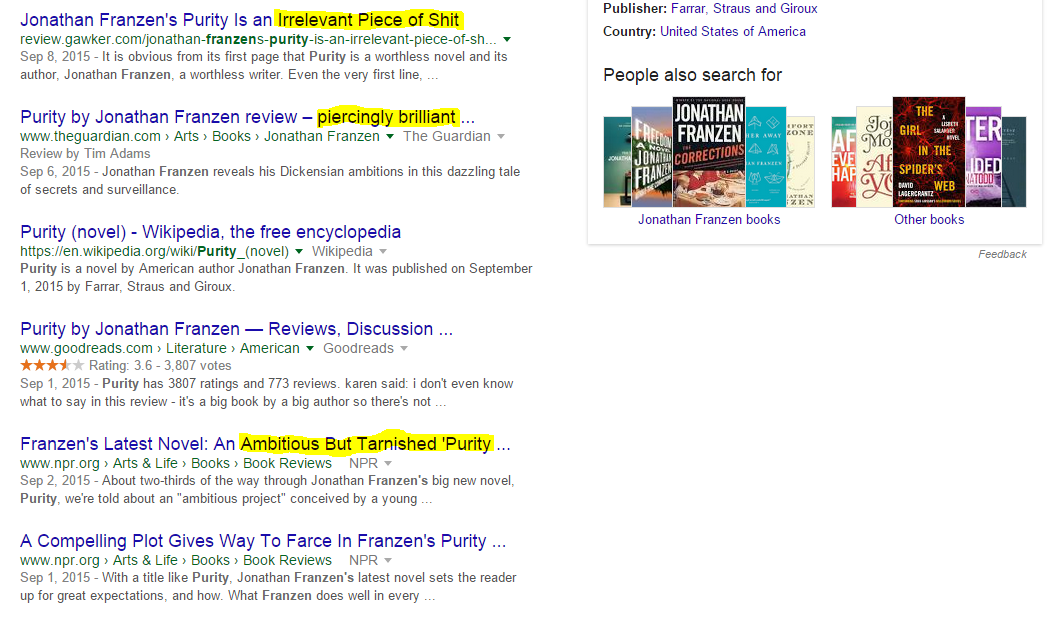
 

Capture

Sycophants and haters. Everyone seems to be one or the other

For What It’s Worth (A.K.A. My Opinion)

Out of all the books I’ve read in the last month, this is the one that has haunted my dreams and made dreamscapes out my days. It’s like I’m lovesick. It’s taken me to another world, and it’s a world I haven’t been able to leave.

Let me be clear—Purity is not without its flaws (and I’m going to tackle the main flaw in a future post). Let me also be clear about this, though. Its flaws do nothing to stand in the way of how much I loved this book, loved the experience of reading the book, and love remembering the book.

And that’s really the difference between how I’ve felt about the other books I’ve been reading lately, even maybe in the last year. I’ve admired the craftsmanship of other books. I’ve been entertained and charmed and filled with respect. But I just flat out LOVE Purity. It hits something deep inside of me—the part that likes to get lost in stories and be swept up by the romance of a narrative completely separate from your own life, the part that likes to completely lose myself in a magnetic world that runs deep.

Creating Character Depth Through Confounding

The other day, I had lunch with a colleague, and he described an idea. He wanted to write a book with his wife, but with a fun twist. He would write one chapter, his wife would write the next, and so on, back and forth. Neither would get to see what the other wrote until it was his/her turn to take over the book.

Beautiful sugar skull woman illustration. Day of dead vector illustration.That got us talking about the genre of the progressive novel. If you haven’t heard of things like round robin writing and the exquisite corpse (see left for what I picture when I say that), well, they’re essentially vehicles for people to collaborate on a story or work of art.
Check them out. They’re fun, and as I’m seeing, they can be useful projects to use as inspiration in solo writing later. But first, creative writing class.

Confound It!

Our lunch conversation led to me remember one of my creative writing workshops. This one was called “Confound It!” or something like that. I might just be making that up. Whatever. If I am, I’m doing a good job because it sounds cool.

It was a collaborative writing exercise in which everyone would write a paragraph, pair up with someone, and switch papers. You would read your partner’s paragraph and write their next one. Except you weren’t supposed to be nice. Your goal was to confound your partner. You were to give them a paragraph that utterly changed the course of what they were writing and forced them to try to recover from whatever disasters you created.

So in “Confound It!,” paragraph one goes like this:

A young man sits and has a heart-to-heart with his estranged, dying father. They hash out old demons from the young man’s childhood. The son finally had the courage to tell his father he had felt abandoned by the old man his whole life.

Paragraph two goes like this:

Not far from the hospital, the abominable snowman, like the young man, was tired of a lifetime of rejection. So, using methods not described in this paragraph, he procured a cache of enriched uranium, and now we’re in the midst of a nuclear winter only he–and for some unspecified scientific reason, also flamingos–could survive.

Paragraph three goes like this:

Dude, come on.

Or maybe it goes like this:

Even the flamingos rejected the abominable snowman, and he learned that extracting revenge through violence was never going to fix the pain he felt inside. The young man at least died, albeit in a mushroom cloud, with a clear conscious after attempting to reconcile through conversation.

This is also kind of the plot of Frankenstein. See, I’m not a very good creative writer even when I’m plagiarizing.

But Confounding Yourself…

The last few Pulitzer-journey books that have graced my bedside table have reminded me of this exercise. These authors’ technique isn’t collaborative in nature, though. Thier goal seems to be to confound themselves. They carefully set up character development in one chapter and then completely undo their work in the next. But this isn’t bad writing. Or rather, it’s bad writing like a fox. (I’m not very good with simile, either.)

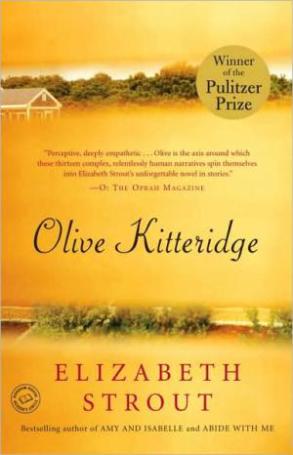
The first book that reveals this technique is Olive Kitteridge. In chapter one, we see a harpy wife nagging her sweet, mild mannered husband, berating him in front of guests and drowning him in a sea of “I cook for you, I clean for you, and what thanks do I get?” Olive is extremely unlikeable in this chapter. But in the very next chapter, author Strout undoes all that hard character work–or rather, she complicates it. Olive is a strong woman who knows exactly when people are in trouble. There’s a man in a truck who’s contemplating suicide, and Olive sees him and invites herself into the car. Even though he’s largely silent, she perceives what’s going on. What’s more, she deals with it in just the right way. She’s solemn and strong and doesn’t sugarcoat things. There are few words exchanged, but her curt observations about the world and his family were exactly what he needed to hear to feel less alone. We see that Olive has a soul, and it’s a soul capable of reaching out to others in a deep way. We can also sense that Olive has scars herself.

The author keeps this up. Olive vacillates between being awful and understandable and human and cruel, depending on the chapter. And, the way Strout does it, you don’t feel like it’s that the character isn’t well formed. As I said in my overview on the book, it seems like she’s known every character in the book for years.*

I’m reading the 2008 winner now, The Brief Wondrous Life of Oscar Wao. It’s happening here, too. Oscar and Lola’s mother, Beli, is pure evil in the second chapter. She’s abusive and manipulative in ways that turn your stomach. And when Lola understands she’ll never be perfect enough to make her mother’s abuse stop–and, besides, she doesn’t have the energy to try–the house gets dangerously hostile. Lola has to run. Junot Diaz, the author, has clearly made this character the villain of the book.

Just kidding! He doubles back on chapter two’s character work in the very next chapter. There, we meet Beli as a child, and we understand that she’s a broken little orphan, shattered by the world and with the same impulses we saw in her daughter in chapter two–the need to run. In fact, the author uses the unusual technique of calling her “our” Beli, burdening the reader with responsibility for who she becomes, forcing kinship with her in an insidious way.

When I think of what the authors are doing here, it could very easily backfire. The characters could appear inconsistent, confusing, ungraspable. But when handled right, this act of confounding themselves helps authors use each twist to turn the screw deeper into the wall, anchoring the character as an individual with complexities that reflect real humans. It’s a fascinating technique.


*Guys. Guys. I thought of the best pickup line for Elizabeth Strout. I forgot to put it in my overview post.

Setting: Bar
Me: Hey girl. Are you Zeus, because your characters spring from your head fully formed
Strout: ~Asks bartender for the check, excuses herself~

I’m not good at pickup lines, either.

Olive Kitteridge: Overview

Nothing like a two-week jaunt, especially with a few transatlantic flights thrown it, to give you the chance to catch up on some reading. I polished off three books on my beautiful trip to France, the first being Even Cowgirls Get the Blues (which I talk about here). The second book I polished off is part of my Pulitzer journey: Elizabeth Strout’s Olive Kitteridge, winner of the 2009 literature prize.

Coincidentally, a few days after finishing it, I saw that a show of the same name was taking the Emmys by storm. I had no idea they had made it into a show. Has anyone seen it? Opinions? (And what’s up with them making a show from A Visit From the Goon Squad? I’m over here tapping my foot, staring at my watch…)

Anyway, if they keep to the book at all, it’s bound to be a wonderful show. Olive Kitteridge was a sober, minimalist book, but don’t let that keep you away. It’s excellent in every way.

Tl;dr Synopsis


Speaking of A Visit From the Goon Squad, Olive Kitteridge is hybrid novel and series of short stories in which every chapter is tied to the last one via characters, without strict regard to chronology or continuity. But that’s really where similarities between the two Pulitzer winners end.

Olive Kitteridge takes place in a small Maine town, focusing on the residents there. It’s a beautiful book full of snapshots. Each chapter is a snippet of a life. You’ll encounter recurring characters in the chapters, especially Olive herself; she is involved in some way in nearly all of the stories. You’ll, in some ways, follow Olive from middle age to her twilight years and watch how she deals with the disappointments of everyday life. (Hint: with grizzle.) In other ways, you’ll just watch pieces of the townsfolks’ lives pass you by. You’ll be plopped in the middle of their story and in some ways be left to wonder how they got to where they were before you met them and what will happen to them later. That information usually never comes, but Strout manages to make this lack of information okay by resolving each chapter in a satisfying way.

Strout captures the essence of a rural small town perfectly. This seems like a book set oddly in the past, as if the town is still stuck in the thirties even as it’s clear that at least some of the book takes place post-9/11. When teenagers Tim and Nina storm on the scene with their phones and parties and modern vernacular, it seems as if they are aliens from the future come to throw the book completely out of whack, which is exactly how I imagine every person in the Maine town would feel about such people. These are simple folks who live simple lives, and the appropriately simple writing emphasizes that. Yet Strout still deals with the complexity of the human experience–depression, disappointment, humiliation, and even sometimes joy–without short-changing it in Olive Kitteridge.

Writing Style

Olive Kitteridge, as I said above, is quite somber. It takes a bare-minimalist, Hemingway-like approach to writing that really works for Strout. (Can I say, too, how many wonderful women writers they’re awarding Pulitzers to?) The author does a great job of showing and not telling. Melissa Bank from NPR says it well when she says, “The writing is so perfect you don’t even notice it…it’s less like reading a story than experiencing it firsthand.”

A short example is from one of the times we first meet Olive. A couple is over for dinner, and the very sweet, somewhat dopey, and rather abused Henry Kitteridge knocks something over at the table and Olive berates him in a way that makes you cringe for the houseguests. Strout knows she doesn’t have to say anything about how awkward anyone there felt. You can just feel it from the events alone, and there’s the added bonus of starting to see what it’s like to be around Olive.

I think one of the key examples of the simplicity of the story is later on, on the day of Olive’s son’s wedding. Olive has made herself a dress from scratch for the occasion–a bright print dress that she’s very pleased with. She looks at it several times with pride. Then, later, when she’s tired and goes to her son’s bedroom to lie down, she overhears her new daughter-in-law and other girls talking about how embarrassed for Olive they were that she could wear the dress in public. The author doesn’t do what many other authors might: talk about Olive’s anger or her self-loathing or sadness, or even something as subtle as heat rising to Olive’s face. Instead, the author stays fairly far out of the narrative other than to describe Olive’s delicious act of taking a permanent marker, finding one of the daughter-in-law’s cream sweaters near the bottom of a folded pile, and putting a bold mark across it, and folding it back into the pile. That’s pretty much all you get, and it’s more than enough.

Olive Kitteridge deals head-on with a lot of tragedy and loneliness, but it’s written in the least sentimental way possible. It lends the book a rawness and authenticity that’s striking. This is a book that stays with you, and it doesn’t use any cheap tactics to burrow its way into your heart.

Characters

The sheer number of characters you meet is rather daunting. Check the Wikipedia list. I count 94. You only hear about many of them once, though, and there isn’t a lot of pressure to remember them or confusion when they come back into the picture. It’s your own, personal little Easter egg if you remember, for instance, that the Daisy who nurses anorexic Nina is the same Daisy that Henry Kitteridge greats at church in the beginning of the novel. It’s a lot like how you can watch a random Law and Order episode and it really doesn’t matter much if you’ve been keeping up with the personal lives of the detectives. (Unless, of course, it’s SVU, which has devolved into a bit of a soap opera. Today’s blog post is turning into “Amanda’s Thoughts: T.V. Edition.” I’ll try to get back on track.)

The characters are all individuals. No one is going to be confused with the other, and you get the feeling that all 94 of these people are fully-formed individuals that the author has fleshed out before writing the novel. It’s amazing.

The characters are not necessarily likable. They waver back and forth. I changed my mind every chapter about how I felt about the Kitteridges. Sometimes I thought Henry was so sweet, sometimes I thought he was an absolute idiot, then I would feel bad about that and think he was sweet again. It’s really a lot how real relationships go, with a kind of ebb and flow to how you feel about the person as both of you grow and change and have interactions.   

Highlights

You know, I found the first chapter to be a little jarring. There’s a serious feeling of being dropped out of a plane into the middle of a story, and you feel a little bit like someone may have torn out the first few pages of your book and you’re missing something. But looking back, I think the first chapter was my favorite. Olive sure isn’t cast in a good light in the beginning, but that first chapter is full of wonderful nostalgia and human connection and longing and remembrance. Oh, and you’ll learn more about Olive and feel for her later. The things she says in the beginning come from a place that you’ll understand, and you’ll be given the freedom to respect her, I think. See, I’m talking about these people like they’re real. They feel real.

Another highlight is all the chapters that portray people in love. Look for the chapter on Daisy and Harmon, for instance. There’s some sadness in it, but I mostly think it’s a beautifully hopeful chapter. There aren’t many of those, but the ones that exist are an experience akin to stuffing your face with Noodles & Co.’s mac and cheese. They feel indulgent and comforting. The book closes on that kind of note, and it’s pretty great.

Who Should Read this Book

I hate to say this because this book really is a masterpiece. But I don’t think it’s for everyone. It’s heavy. There are few moments of happiness in Olive Kitteridge, and the ones that exist are tinged with something undefinable that makes your heart ache. I think this is undercover one of the saddest books I’ve ever read. I say undercover because it isn’t like the reader’s constantly dealing with death after death after brutal heartbreak, etc. Olive Kitteridge mostly just deals with insidious disappointments that quietly accumulate day by day. When faced with it like this, in digestible book format, forced to acknowledge it over a few sittings, it’s hard not to feel like life itself isn’t something quite sad altogether.

So. If you’re a beach-reader who prefers lighthearted stuff and mainly uses books as a happy escape (no judgement here on that), this book might not be for you.

But if you’re okay with heavier stuff, it’s worth it to experience the craft of this book. The writing is executed in a way that stuns me. Strout does everything right. If I were teaching creative writing, which I am utterly unqualified to do, this book would be on my required reading list. It’s an example of writing at its best. And, despite the sadness, I really loved reading it. The book is gorgeous.

For What It’s Worth (A.K.A. My Opinion)

Wow, I think I already got it all out of my system.

If you can, you should at least try to read this. The writing stands in a category by itself, and the stories are gripping. It’s an experience that I think you should have, if it suits you.


On Editing, Part Three: How to Become an Editor

Proofreading red pencil with various errors on paper

This has been a series of posts on disconnects. So far, the series has covered the disconnect between the editing people need and what they think they need and the disconnect between what people are willing to pay and what an editor needs to make per hour. This last post is on the disconnect between English courses at school and editing in the real world, and it’s all the things I wish I would have known a few years ago.

A few months ago, I was having a drink with a fellow language-lover. We were catching up on where each other was at in her life, and she asked, “So, how does one go to school to be an editor, exactly?” The implication, I suppose, was that step one (I went to school) led to step two (I’m an editor). It’s not an unreasonable thing to assume.

I thought for a second and said, “Um…one doesn’t.”

That isn’t to say one can’t, necessarily. The college I went to offered two English major tracks: writing and literature. I chose the literature track (which, by the way, demanded just as much writing as the other track). At no point was there offered any class on advanced grammar, linguistics, or the skill of editing.

Now, larger and differently-focused schools may offer editing classes, especially if they’re well known for their journalism programs. Of course, being an editor in the journalism world often actually means you’re writing. But you can seek out schools with editing courses.

For some, though, that’s not the most practical course of action to take. Editing and advanced grammar classes are not very easy to come by, I’ve found. And even then, they’re courses, not degrees.

You do need a degree, of course. English is best, but you might be able to squeak in with a communications, journalism or marketing degree. But this isn’t the way you will learn how to be an editor. A degree is your way into the door of a company.

If you want to be an editor, your training is in your own hands. Here’s how you really learn how to be an editor.

Learn Your Grammar

The first thing you want to do is become more grammar-savvy than the layman. You probably already are, if you’re thinking about going into this field. But you need to strategize around defense, especially if you’re just starting out. Assume someone is going to call you on every edit you make. If you know the rules, you can make many of these changes with confidence.

Figure our your parts of speech, your dependent and independent clauses, and your active and passive verbs. Learn to speak the language of grammarians. It will help you begin to understand how sentences work, and when those secrets are unlocked, sentences will become putty in your hands. Instead of thinking, “There’s just something awkward about this,” you’ll think, “Oh, of course this sentence sounding sing-song-y. It has five prepositional phrases in a row.”

Here’s where you start: at the 90s-tastic but still very useful website Garden of Phrases. Start on page one and take the quiz. Then select “quizzes” from the dropdown and start taking them all. It’s a brutal wake-up call. But you need to know what you don’t know.

From there, learn to diagram sentences. I got this workbook: I don’t know if I’m crazy about it, but lots of people are. Don’t get too hung up in mastering 100% of the details right away, like I did. Just plow through it.

Also, become zen about Murphry’s Law, if you write as well. There will be at least five errors in every post I make about grammar and editing. I try not to post garbage or anything, but if I actually strived for 100% perfection in everything I wrote, no one would ever hear a peep from me. I would just be sitting in front of the keyboard, shaking in terror. Don’t get so worked up about the rules that you can’t function, but know them.

Learn Your Style Guides

Following a style guide is what makes sure all things in the text are harmonious. These guides deal with issues that aren’t usually a matter of grammar, and they aren’t dictating what’s universally right or wrong. You can write a date as 9/5/15 or you can write it as September 5th, 2015. Neither are wrong. But you shouldn’t use both styles in one text. That’s where style guides come in.

The Chicago Manual of Style and the Associated Press (AP) Stylebook are your two must-know guides. Learn the key differences between these two, and you’ll be in good shape. As a starter kit, buy a copy of each guide that’s one edition old–you’ll save money, and you can quickly find out what’s been updated in the new versions with a Google search. And for light reading, check out AP vs Chicago for the essential differences. It kills me that this blog is inactive because it’s been a marvelous resource to me over the years. Plus, the author is a delight.

You can check out my own in-house style guide I made for a company (and you can tell me about any grammar errors you find). Some of the decisions I made about style itself was because I was swimming upstream against legacy, but there is some advice in there you might find interesting.

Here are some books on general style that are beneficial and/or fun to read. They are not by any means holy grail resources, since so much of style is personal preference. (Except Steven Pinker’s book. Everything in there is gold.)

Eats, Shoots & Leaves by Lynne Truss–A little prescriptivist and “thou shalt” for my taste, but I’m better for reading it

Lapsing into a Comma by Bill Walsh–and I can probably blindly recommend anything else he’s written. I loved this book and am dying to read his others. Bill is an editor for the Washington Post, and he is hilarious and brilliant. I don’t agree with every little thing he says in this book, but I love all of it anyway. He also does live chats called Grammar Geekery the first Thursday of every month, where he’s answered tons of my questions. But even if you don’t need answers, you should lurk just to watch his on-point, delightful snark at work.

The Elements of Style by Strunk and White—Dated, troubling in many cases, perpetuates zombie rules, but, well, you have to at least have read it. You can’t be the editor that isn’t at least able to argue about Strunk and White.

Besides, “omit needless words” is an editorial mantra that should stand for all time. If nothing else, that phrase redeems much of the stylistic quackery.

When You Catch an Adjective, Kill It by Ben Yagoda—Ben’s another great editor to keep tabs on, and this book will help you better understand the parts of speech and where they can go wrong.

The Sense of Style by Steven Pinker—A forward-thinking, beautifully written piece from a linguist who really understands how the written word works. I’ll be honest; I haven’t finished it yet. I’ve been too busy. But it’s so far been my absolute favorite book on style. Pinker is in the descriptivist camp, and with his ideas come great freedom to believe writing is improving as we communicate more and more. (See here for a description of prescriptivist vs descriptivist schools of thought. Hint: descriptivists are always on the right side of history.) He is a fan of deflating self-important academic/business writing in order to communicate with simplicity and elegance.

Follow Thought Leaders and Have Reliable Sources

Subscribe to the blog Lingua Franca, and keep your eye on people like Ben Yagoda and Geoffrey Pullman. Follow the marvelous Tom Freeman at the Stroppy Editor, though keep in mind that he’s operating under a slightly different set of rules due to geographic location. (And if you’re not American, beg pardon—it’s actually Americans who are operating under the different rules, of course.) I also subscribe to Baltimore Sun editor John McIntyre’s You Don’t Say, although you may want to avoid his blog if you have a low tolerance for politics. Keep tabs on the American Copy Editors Society (ACES) even if you don’t join. You can tweet to the editors at the Wichita Eagle @grammarmonkeys if you have any questions about grammar and editing. It’s an awesome service.

But most of all, if you have questions, learn where to go for answers you trust. If I can’t find answers in my copy of the Chicago Manual of Style or if I know my question is purely grammar-related, I go to straight to the English Language Stack Exchange, where a meritocracy and a community of field experts guarantees a good answer. Search for your question before you ask. The community is a little hostile if they think you’re being lazy. But it’s my favorite resource, and it’s never steered me wrong. It also deals with really complex questions.

There are other good resources. Purdue’s OWL is not comprehensive, but it’s very useful and reliable. If you go to Google with a question, and anything shows up with the address “grammar.ccc.commnet.edu” attached to it, it’s going to be trustworthy—that’s the site with the Garden of Phrases. Things from Jane Strauss’ Grammar Book tend to be correct, as well, although I’d be wary of that site being out of the loop for too long. It’s also worth saying Grammar Girl is totally worth the hype. If she’s addressed your question, she’s got it right. Sometimes, but not always, academic resources can be helpful. Look for .edu as a tag at the end of the URL. But the correctness of .edu sites is not a given.

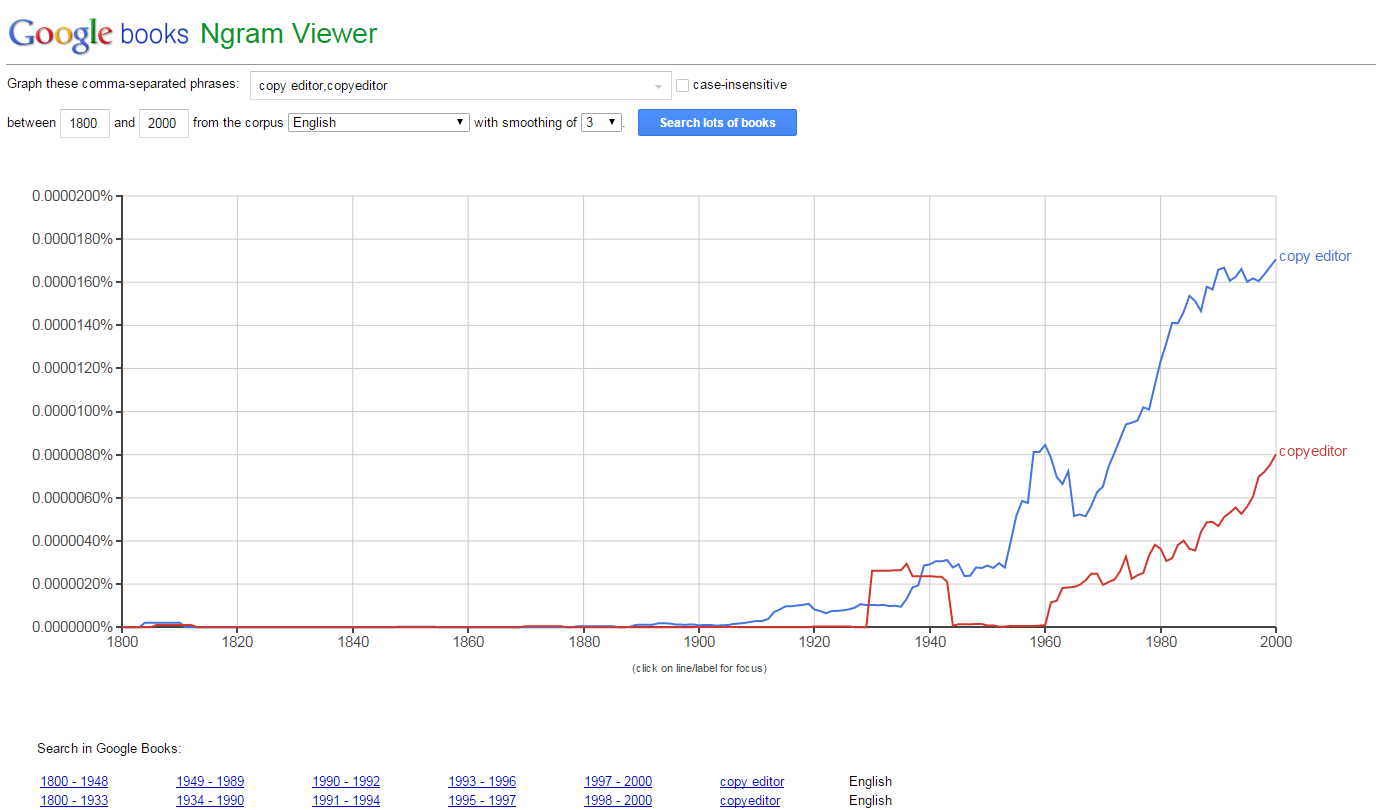
Also, if you have two editorial choices you’re wavering between, check out Google NGrams. It searches Google Books for your terms. That means you’re not necessarily looking up the right answer, but you are seeing at usage over time and trends. It’s useful for a lot of things. For instance, I can see that I’m not making the best decision by choosing to leave the space out of “copyeditor.”

Capture

Lastly, I hope it goes without saying that you never, never go to forums like Yahoo Answers. That’s where all truth goes to die.

Start Editing, Even if You Have No Idea What You’re Doing

Offer to edit people’s blogs for free. Contact a small non-profit you love and offer to proofread their newsletter. Become an editor on your school newspaper or offer to do a little proofreading for your town’s community center. When you start, research the answer to absolutely EVERY question you have—never guess—and keep a list of your answers.

What really prepared me to be an editor had nothing to do with my coursework. It was tutoring at my writing center. Our writing center was no joke. I had four months of intensive training. I learned so much about research, argument structure, thesis-building, checking for coherency, writing for readers, how to self-edit, you name it. That was the true foundation to me becoming more than someone who just had a “feel” for what is right/wrong or clear/awkward. It was what bridged the gap between me just being a good second pair of eyes on text to being what is a real-deal editor. If you have an opportunity like this, take it. If you don’t have the opportunity for training like this, well, let me know. I was thinking of maybe starting a program that can do for others what this writing center did for me.

Have a Real Editor Look at Your Resume

Don’t have your mom read your resume. Don’t give it to college advisor. I mean, you can also do that. But if you’re applying to be an editor for the first time, you’ve got to get that resume in front of an actual editor. There are things you don’t know you’re doing wrong that can bump you off the radar if someone who knows what he/she’s doing is narrowing the field of applicants. I just looked at the resume I sent out as a fresh grad and I was horrified to see I had separated dates (as in “worked here September of 2010 through June of 2012”) with a hyphen instead of an n-dash. That might not seem like a big deal. But if I were hiring an assistant editor now and was looking through a pile of resumes, and all I’m looking for is a reason to throw some of them out, that hyphen tells me, “Oh. This person is too much of a newbie or doesn’t pay enough attention to detail to know that this isn’t how you treat dates.” Then I toss it to the side.

Get a real editor’s eyes on your resume. At least make sure the door doesn’t close prematurely.

I’m pleased to announce this part is pretty easy. I’m a real editor, and I’m happy to take a look at your resume if you’re starting out. No charge. I’m currently trying to build up good karma so I can go do something awful later and not be reincarnated as a cicada.

On Editing, Part Two: The Practicality of Editing

Two to too error found while proofreading paper

In my last post in this series, I wrote about the different levels of editing. In this post, I want to talk about the value proposition of having these layers of edit built in, or, more bluntly, the unquantifiable nature of that value, dollar-wise, for the individual. This is one of the disconnects that’s been bothering me: the disconnect between what people are willing to pay and what it costs in time for an editor to work.

The Market Problem

There are a lot of freelance editors out there that seem to be making it just fine, but I also hear a lot of complaints about being underbid by unqualified, inexperienced editors. These disgruntled folks argue that this brings down the expected rate for real editors, and it becomes impossible for professionals to make a living without lowering their standards for their work. I understand their complaint, but I don’t really have a lot of sympathy for the argument. Markets have a way of sorting themselves out, and if it’s really important for people to have professional editing, they will only make the mistake of hiring someone cheap once. If it’s not important, well, either you’ve overinflated the importance of your work or you’re not making a good business case for your skills.

But this is where I worry. I believe wholeheartedly in the necessity of an editor if you want to your written content to be taken seriously.  I’m also a pragmatist. I understand that you have to make a dollars-based case for things. How does an editor create a value proposition, contrasting the “without an editor” copy with the “with an editor” copy? And even if one could do that, would the dollar amount really be high enough to support hiring an editor, if you’re an author? It’s difficult for me to put make a case that isn’t more abstract than I’d like it to be. (As an aside, I’m planning on putting the Freakonomics guys on the case.)

These concerns are somewhat dulled by salaried employment. Your whole reason coming to an establishment and sitting in your office is to edit, so your value is somewhat decoupled from the work per hour itself. Certainly, there are deadlines, but you can just pump out a little overtime to get them perfect and then relax a bit next week. You get paid the same either way.

But what if you’re freelance and just looking to work with individual authors or copywriters? What if a particularly challenging piece would take weeks of work, and you charge by the hour? Or, worse, what if you charge by the word and you’ve underestimated the time you’d spend getting it to your standards? Now you’re talking about doing hundreds or maybe thousands of dollars of work and dealing with one of two scenarios: working for a wage that doesn’t sustain you or getting a response from a client that says “$700 to hunt for typos?” (Which is what many individuals think you’re doing–see my previous “On Editing” post.)

Now, certainly there are savvy clients and experienced writers who know this price is coming. All you need to do is go to Google and check for average editor’s hourly rates. Businesses will know what they’re getting into and know the value of a good editor, which is why scoring a business-based clientele as a freelancer is really your ticket. But the thing I find, and the thing that causes me consternation, is that the layman author just doesn’t care enough about it being perfect to pay for it, and I can’t say I blame him.

The Problem, in Anecdote Form

Let me give you an example. My husband’s a great writer. He’s a popular blogger, and I edit his posts every once in a while, when I have spare time. He’s a dream to edit, compared to most writers I’ve worked with. But when I edit him, I always find a few typos and a decent number of sentences that need rearranging or breaking up. I also read his posts very carefully to make sure I understand what he’s getting at and that I’m not changing anything that would alter his meaning. To get his posts to the level of perfect that’s up to my standards, it takes me 45 minutes to an hour to go through a 1,200 word post. One time, I asked him how much he would pay someone to do what I’m doing, and he said, “Honestly? Five or ten bucks a post. Maybe less. I write three posts a week, and people like my unedited writing enough that it really isn’t worth much, money-wise, to have them perfect.” And that is a totally reasonable thing to conclude.

I’m remembering, too, the time a friend came to me all excited about a book he was writing. He described the plot and told me what he estimated the page count to be. (It was roughly a quadrillion; he’s a man of many words.) He said he was really excited to have me edit it and asked if I could give him an estimate as to how much it would cost. After straightening out what he meant by “page”–very important to be speaking the same language of what a page is before an estimate, if you’re a freelancer–I gave him a quote with a buddy-discount of 40% off built in. He was still stunned into silence at the number.

Unfortunately, that means bad things for me. My skills and my meticulousness just aren’t really worth very much to individuals. To companies, maybe I’m a great investment, but I find I really prefer to work with people. And here I see a disconnect between what I have to offer, what I need to charge, and what my skill is actually worth. That’s a pretty rough thing to have to come to terms with.

Solutions(?)

So I’ve been thinking. When I edit, I edit for readers like me. I edit as if another editor is going read what I’m working on. I edit as if I’m claiming sole responsibility for every line that isn’t the best it could be. I want everything I touch to be something both I and the author can share pride in. But maybe this isn’t always what the market wants.

I’m not really talking about lowering my standards as much as I’m talking about filling a market need. When people want a rush on things at work and ask how long it will take, I’ll give them the option of “an Amanda edit or a normal-people edit.” They know that to mean, “Do you want me to fix the things only people like me would know are wrong, i.e., make it perfect? Or do you want me to look for any embarrassing or obvious mistakes?” Which of those two they choose makes a big difference in my estimation of time . So I wonder if there wouldn’t be a market for my “normal-people edit” service, in which an editor doesn’t concern herself so much with every sentence living up to its potential or common capitalization errors or the interchangeably used and and ampersand. Or maybe there’s room in the market for an a la carte type of edit. People can say, “I know I have trouble with homonyms. Can you make sure I used the right words in this piece?”

Even better, I wonder if there’d be a market for a partnership. What if an editor analyzes a few pieces from an author, tells him the patterns of error he should be looking out for (e.g., “you tend to use really long lists that will make people space out,” “you use nothing but versions of ‘to be’ verbs that make your writing kind of snoozy,” “your bullet points are never parallel,” “you have subject/verb agreement trouble”) and do custom edits just for those things.

The real problem with that is, for me, it’s really hard for me to limit myself. If I see a fragment, by god, I have to fix it. Double space after a period? NO. The wrong “its”? One eye will start twitching furiously like I’m some kind of maniac.

There’s also the problem with the fact that I won’t be proud of the work I’m helping people produce. It won’t be the best it could be. I won’t want my name on it, and it’s not satisfying work. Frankly, it’s a little soul-sucking, too, unless I feel like my goal isn’t really editing as much as it is making people better writers.

Maybe I’m destined to lose money freelance editing.

On Editing, Part One: The Kinds of Editing

Proofreading its error on school term paper

I’m going divert from my normal course to do a series of posts on editing over the next few weeks.

I’ve been thinking lately about disconnects. There’s the disconnect between what editing services people think they need and what they really need. There’s the disconnect between what people are willing to pay and what it costs in time for an editor to work. And there’s a very important disconnect between English courses at school and editing in the real world. That’s led me to plan a series of posts I’ll call, in my infinite creativity, “On Editing.”

The Kinds of Editi—Wait, There Are Kinds?

Most people think that being an editor generally means you’re the grammar police. When I tell people I’m an editor for a living, I’ll usually get a response like, “Oh, so you check for typos and grammar mistakes and stuff.” And certainly, most editors will probably try to prevent those things from slipping by.

But “editing” is a word like “love.” (Sincerest apologies. I just got married and I’m feeling cheesy.) There are different forms it can take. That’s why editing is usually divided into three different categories: developmental, copyediting, and proofreading. They are in some ways fluid, just as “love” encomapasses different types of affection with undertones that can flow. But here’s my best attempt at a breakdown of the three types.

1. Developmental Editing

If you’re scratched out half a novel and are feeling the pain of being too close to the work, a good developmental editor will see the soul inside the text and help you understand how to bring it out. If you’re writing up a proposal, a developmental editor will help you brainstorm the message you want to convey and will help guide you through your main points and keep your paragraphs on task. This person will take your current work, look at the ideas presented in it, and help you understand how to tie it all together in a structure that packs punch. In the academic world, we referred to this as the process of thesis building and global structure development. But as a person that’s been in the world outside of the academic essay for some time, I think of it in a different way.

That way is this: whether you’re writing a sci-fi novel or a white paper, your developmental editor is your midwife. He/she will bring your baby into the world, and that baby will have all its eyes and toes and fingernails in the right places if the editor has done their job right. These people work closer with your text than anyone in some ways because they’re focused on your ideas–the whole reason you’re writing in the first place.

I know an editor who primarily works with poetry, and she embodies all that a good developmental editor should be. She sees someone’s poem, and it’s as if she instantly understands what the author is going for, inside and out. Then she sneaks in like a surgeon. When she’s done, the poem is somehow more itself than when she started. The author barely knows she’s been there–all he thinks is “Wow, I wrote something pretty great!”

It’s working with her that has made me see what developmental editing is–it’s coaxing an already-formed butterfly out of a cocoon.

Developmental editing is my favorite, probably because I think it’s the most rewarding.

2. Copyediting

Copyediting deals with the sentence-level stuff (and believe me, there will be sentence level stuff). It also may deal with things like fact-checking, style, and, if applicable, footnotes and references. For fiction, your copyeditor is also charged with noticing inconsistencies like your redheaded character flipping what’s described as brown tresses later on in your novel.

Copyeditors will ask you what style guide you’re dealing with, and that will help guide them to know how to consistently address things that have no right or wrong answer. Should your m-dashes be buffered by spaces? Should California be abbreviated CA or Calif.? And, hey, is it “copy editor” or “copyeditor”? There’s no right answer, per se, but there are style guides that call for different treatments. (And, by the way, “copyeditor” as one word is a personal preference of mine since I believe language constantly moves toward portmanteau, hyphen elimination, and word combination [and I’m an early adopter], but you’re probably safer saying “copy editor.”)

Most importantly, the copyeditor will make your sentences not only grammatically correct but readable. The copyeditor’s main goal should be clarity and communication at the sentence level.

This, unfortunately for those writers who are sensitive, often requires rewrites of sentences. If a sentence has parallel structure issues or misplaced/dangling/squinting modifiers, this almost always requires a rewrite. If an author has a habit of writing long, sprawling sentences where the subject is separated from its verb by two lines of text, it simply has to be rephrased. This is why, when people ask for a proofread, they often really need a copyedit. Their errors are not ones that can be fixed by adding a comma. Sentences need to be chopped up and reassembled. Sometimes, they need to be placed somewhere else in the document completely to make sense.

More than that, copyeditors work with tone. It’s easy enough to edit out contractions from a professional piece of correspondence, but what if an author who prides herself on having what she perceives as an affable, conversational writing style hands over something that is way too cute and flippant for the material under discussion?

Copyeditors are often workhorses, and they are trained diplomats. Except in the world of professional workflows employed by big-boy publishers and print and online media companies, they usually have to do a little of all three types of editing ’cause this text isn’t going to anyone else. They’re all the editors packed into one.

Not only must they catch the missing word in the sentence that’s so easy for the eye to skim over, they have to think about what the person is saying and if the sentence conveys their meaning. And what’s more, they have to think about how to share their edits with this author in a way that doesn’t ruffle any feathers.

Hug a copyeditor today.

3. Proofreading

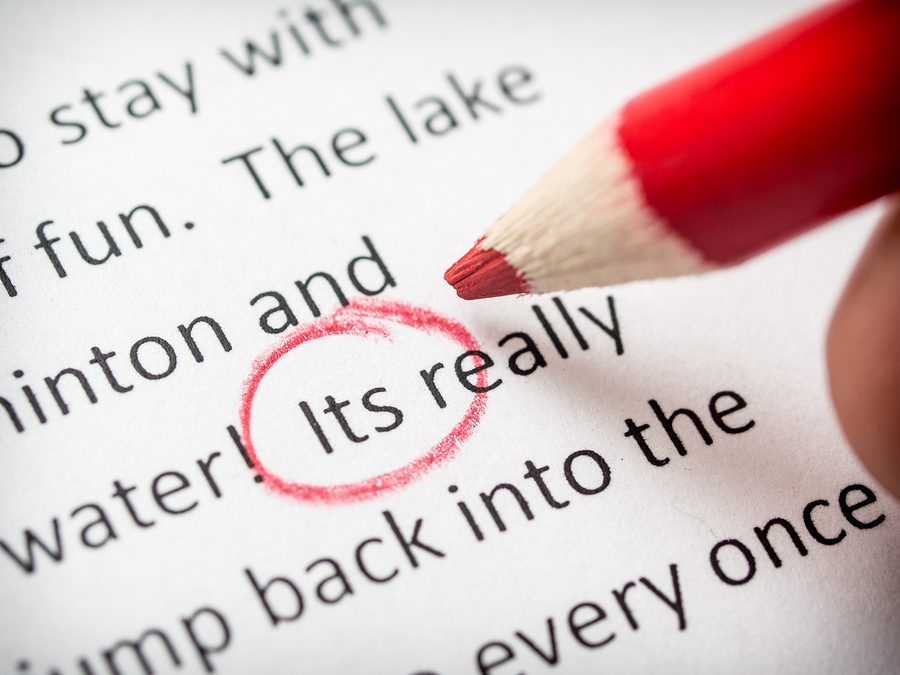
I can’t say this emphatically enough–a proofread is not what you need unless you’ve been copyedited. Proofreading is last-ditch, pre-publication typo-catching. It’s finding missing words, misplaced commas, use of the wrong “its.” A proofreader will also double check stylistic things–was the name of a magazine italicised here but not later in the article? Are there periods at the end of each bullet point in this list but no punctuation at the end of the bullet points on the next page? Proofreading is the final step before publishing–it’s just there to catch errors and little inconsistencies, like the font being a different size for the captions on page 6.

Proofreading sounds like the easiest form of editing–and if the copyeditor has done a good job, it probably is pretty easy. But it’s my least favorite type, and I’ll tell you why. You have to have a real eye, even a talent, for spotting detail. Your eyes are the last to see this text. If you miss something, oh boy. That doesn’t fall on anyone else but you. There’s a lot of pressure on proofreaders. They’re the ones who are expected to pump out perfect manuscripts. And no human is perfect.

A Clarification

So those are the types of editing. And here’s a tidbit. Whatever level of editing you think you need, it’s probably actually the step before it. I say that not assuming you’re a bad writer. I say that assuming you’re a human being. Every time I’ve been asked to give something a “quick proofread,” it’s needed sentence-level work.

It’s okay if you didn’t know that when you asked. That’s why people like me spend our lives learning new things, figuring out why sometimes you put a comma before “so” and sometimes you don’t, understanding what violates the rules of parallel structure, etc. Frankly, if you’re in pursuit of perfection, the stuff is so complicated that you couldn’t possibly know unless you made it your job to know. You should see the rules around capitalization of position titles. It would make you rip out your hair. Luckily, an editor worth their salt has made it their job to know.

But I’ve told you now. Keep it in mind: there are things grammatically wrong with your sentences (at the very least), and you don’t even know that you don’t know.  So trust me when I say you don’t need a proofread–you need a copyedit. I just know this from experience.

Now you understand the different levels of editing. Yay! Except not yay! Because, if you’re reading this, you’re probably already thinking about the subject of my next post in this series: the practicality of it all. Having three levels of edit, or even two, is all well and good if (a) you run a magazine or (b) you are fantastically wealthy, in both the currencies of time and money. But it isn’t practical for an individual to hire out for this long series of edits. You likely want just a nice overview of your text, sparing you embarrassing mistakes.

This is one of the problems I’ve always had with real, professional editing, where time is taken to get it right. Is it practical?

Stay tuned to hear my non-answer!

Even Cowgirls Get the Blues: Overview

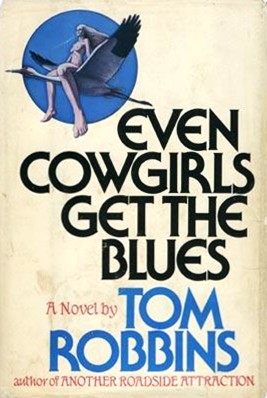
EvenCowgirlsGetTheBlues(1stEd)Have you ever read Thomas Pynchon and thought, “Man. This would be pretty awesome stuff if I could even begin to grasp what on earth he’s talking about”?

If so, Tom Robbins’ Even Cowgirls Get the Blues may be for you.  For all its postmodern whimsy, it’s an actual book with an actual, accessible plot. It’s charming when it’s not being absolutely ridiculous. But then again, ridiculousness is part of its charm to some, I’ll wager.

Tl;dr Synopsis

Sissy, our protagonist, has huge thumbs. I’m not sure if there’s a figurative meaning for that, but if there is, I don’t mean it figuratively. I mean the thumbs on her hand are huge.

She hitchhikes with them. She has a lot of thoughts. The author also has a lot of thoughts.

Sissy’s travels take her to an all-girl ranch, run by Bonanza Jellybean, that is nearly utopia.  Everything in the novel hinges on this place. Even when Sissy leaves shortly after arriving, her heart stays there.

Interesting miscellany ensues. Endangered birds are fed peyote. There is folklore around something called the clockworks, which is difficult to describe, especially since I don’t understand it. A pervy old would-be philosopher on a hill spouts cryptic tidbits of what’s either spiritual knowledge or nonsense. The author interjects himself for a chapter and then scolds himself for interrupting the story.

But it all winds up coming to this: when the world conspires to take the all-girl ranch from the posse, they fight for it. I won’t spoil the ending from there.

Writing Style

Quirktastic. Absolutely off the wall. The beginning of the book is a chapter on amoebas. His style is juicy and visceral, full of colors and joyus screams. You also don’t know what each chapter may bring. At one point, there’s a subchapter: 111a, to be precise. It concludes with “DANGER: RADIATION. Unauthorized personnel not allowed on the premises of chapter 111a.”

Robbins is creative writing at its most creative, and his writing style is postmodern (or “po-mo,” if you’re an insufferable M.F.A. candidate) as can be. The content is a different story–Robbins takes himself quite seriously in many cases. But as far as style goes, he is just as I said before–an accessible Pynchon. He manages to weave an actual, interesting, followable plot in the midst of his zaniness.

Characters

Ah, but here’s the gripe. Normally when I find characters to be the fault of a novel, it’s because they’re trite, cliche, or otherwise unremarkable. Here, they’re all remarkable. That’s because they’re all the author.

It didn’t start out that way. Sissy was unique in the beginning. The Countess is fantastically unique (at least before he gets his marbles rattled). And Bonanza Jellybean, bless her literary figure’s heart, remains unique until the end. But almost all the rest of the characters–Sissy, Dr. Robbins, the Chink (that’s his name, for real)–they all become one voice. One philosophical, cooky, offbeat voice, but one voice nonetheless. It’s like reading an Ayn Rand book. You get the feeling that all characters are just vehicles for the author to speak, as himself.

Some of the girls at the ranch are different from the author. But they aren’t unique. They are archetypes representing different schools of feminism, with Delores Del Ruby being the radical separatist and Debbie being the cultural feminist.  And frankly, they turn into the author at the end, too.

But, oh, my Jellybean. In all her simplicity, she is separate from the author and free of roles. All she wants, and all she’s ever wanted, is to be a cowgirl. And her belief that all people should be able to be whatever they were meant to be, that pure simplicity, makes her the most endearing.

But before I leave the characters section, one note. It’s interesting that who I can only assume is meant to be the villain of the novel, the feminine hygiene magistrate Countess, is one of the best characters in the book. Robbins, who to his credit has written a fantastically girl-centered, girl-empowered, feel-good book, clearly does not identify with the one in his book characterized by his hatred of women. So he separates his voice out from the character and just writes an awesome, funny, unusual, despicable character with prissy tastes and raunchy but to-the-point conversation.

My thoughts? Robbins, over the course of writing the book, fell too in love with some of his characters. He and his characters all started to meld together until no one was distinguishable.

Highlights

“It was about two minutes on the tequila side of sunrise.”

What a great line.

Also, enjoy your time at the ranch, readers. It’s a great place to be. The scenes at the ranch are the best parts of the book, and you will feel as hollow as Sissy did when you have to leave.

I should mention, too–the fun of this book is a highlight. It’s serious at times, but for the most part, it’s an enjoyable, light pleasure cruise of a read without being mindless. It’s like watching a coloring book be filled in with a crazy genius holding the crayons.

Who Should Read this Book

You have to like the off-color and some raunch to enjoy this book. You also have to have a special love of language for its own sake, I think. There are a lot of meandering chapters. But for the most part, this is a really delightful book, and its accessibility is appreciated, considering the genre.

For What It’s Worth (A.K.A. My Opinion)

I had a good time reading this. It put a smile on my face. But it wasn’t all sunshine for me as a reader.

You got the first glimpse into my issue when I discussed the characters. And you may recall that I said the style was postmodern, but the content was not. That’s because the content wasn’t flippant about reason and purpose and deep thought–in fact, it was all up in those things. And that’s the exhausting part, for me. The philosophizing and deep-for-the-sake-of-deep was tiresome, and the characters just wound up being the mouthpiece for the author’s ideas in the end. It’s a little hard to take. Sissy’s thumbs, for instance–you got the feeling there was supposed to be symbolism in there about her being especially evolved (you know, opposable thumb times ten or something), but you also got the feeling it was never really fleshed out in the author’s head. He was just going to throw it out there, and people who got him would get it. Okay, that’s fine. But it’s not exactly brilliant writing.

And there’s more. There’s a huge spiel about how everything in nature is a circle and there’s all the philosophy about time and clocks, and frankly, none of it feels like it was well thought out. It really is like reading Ayn Rand sometimes. “I’m a philosopher! I have big thoughts! Check out these vague and undeveloped big thoughts!” When conversation after conversation goes on like this in the book, I kind of wanted to skip ahead.

But those are harsh words for a book that I enjoyed a lot. I won’t say I’ve never read anything like it, but many readers probably haven’t, and I don’t think I’ve read anything in the genre that was this fun. This is a great avant garde starter book.


Nonfiction: A Tale of Woe

I love knowledge. Actually, no. Love doesn’t quite describe the nature of my relationship with knowledge. It’s something more like codependency. If I’m not learning new things, it feels like there’s an emptiness that needs to be filled, emergency-style. Black-hole-style. Emotionally insecure shop-vac style.

My need for knowledge is neurotic. Say I’m out with a group of people and the conversation wanders to art. Someone is discussing “those pictures with the white rectangles and the primary colors–god, what was that artist’s name?” The others shrug, and all move onto the next subject. Five minutes later, I look up from my phone to interrupt whoever’s talking to shriek, “Piet Mondrian! He’s Dutch! HIs style is called neoplasticism, or De Stijl. You can find a lot of his work at the NY MOMA.” Long pause. Someone coughs. I go back to looking at my phone.

That may be an exaggeration. Sometimes I wait for someone to finish their sentence before shrieking.

Anyway, it isn’t just curiosity. Acquiring knowledge is survival, for me. It’s what makes me excited to be alive. And it’s never enough. I want to know everything–how it works, why it happened, who’s behind it…

Also, you may have noticed (or assumed from the title of the blog) that I enjoy reading. So what’s perfect for a person who loves understanding the ins and outs of everything and also loves reading? Nonfiction, clearly! Nonfiction is perfect for me. Right?

Well, it made sense to me, and it’s why, alongside the Chekhov and the Hardy and the Faulkner, my bookshelf is packed with interesting nonfiction. I’ve collected books about the parts of speech, how cults form, the psychology of Stalin, plate tectonics, the brain chemistry of children, and the list continues. All of it is fascinating. And only a few have even been cracked open since I bought them.

I’ve been reading nothing but nonfiction lately because I want so badly to get the information certain specific books contain. I’m in a place in life where I feel like I need to be equipped. I need revolutionary time-management skills. I need perspective on life before it passes me by. I need to learn how to tackle my fear of flying at the root. I need to understand how to write with clarity and elegance. There’s a series of nonfiction books that I have been meaning to read that will help me do all this. It’s not just knowledge I stand to gain, either. These books will make my life better, and they’ll make me better at what I do. Yet I cannot read nonfiction, at least not without a real push to concentrate. And as I’m reading, I have to renew that push about every five minutes. It’s like my eyes just glaze, and a wall pops up between me and the material.

That’s the real problem with nonfiction. I see the words, but I don’t take them in. I read four pages of material and then realize I haven’t actually processed a word of it. That means going back and trying again, over and over. It’s particularly discouraging because I read quite fast, and there’s nothing like feeling like you’re plowing right through a book only to realize you’ve been spacing out for awhile and you have to go find the last paragraph you remember making sense. So I–who am usually a lightning-fast reader–am stuck in a book for months, working and working to concentrate on what’s being said. It makes it really hard to want to pick up the Kindle.

Why I have this problem, I can’t imagine. I want the information. The information is interesting to me. I have much to gain by taking in the information. My reading comprehension scores on standardized tests were always off the charts. And yet, put me in front of a nonfiction book, and I feel like I may as well be opening up a book in Mandarin.

Sorry to be so absentee and then throw a live-journal-esque monologue at you. I also wanted to announce some changes coming to the site. I’m doing a decent amount of moonlighting, and I’d like to be able to point folks to a place where I more clearly define the services I offer. I figure I may as well integrate it with my blog, since understanding how writing works is key to both how I read and how I edit. I’d like for my hobby and my career to become more integrated than it’s currently been.

Thanks for your patience during long droughts. It’s been a tough few months, reading-wise and everything-wise.

Hate on Franzen. Go Ahead.

But portray the dysfunction of human relationships like he did in The Corrections. I dare you. 

Hey girl.

Anyway. I am EXCITED.

So, if you rely on me for your literary news, (1) I’m sorry, and (2) Jonathan Franzen is coming out with a book named Purity in September. All the world is abuzz with Franzen hate right now, and I’m sorry–I just can’t comprehend it. The main accusation? “His booksexes be all, you know, not sexy and stuff.”

You people. The essence of the sex in his books is that it’s awkward. It’s one of the many things that makes the relationships in his book so believable and so human. So you want perfectly natural scenes of seduction where two fabulously attractive people with great communication skills and no mommy/daddy issues feel free to ask each other to fulfill their deepest desires, fall naturally into perfect sync and find utter satisfaction with one another? End scene; light cigarette? Well. The erotic fiction department of Amazon is thriving, and you, too, can donate your crisp dollars to the cause.

Franzen’s writing reminds me of Dostoyevsky’s Notes from the Underground. We have a character that’s terribly awkward and struggling to connect with others while being cripplingly self-conscious and selfishly single-minded in his pursuit of ephemeral satisfactions–all the while being in terrible psychic distress–these are Franzen’s characters. Faulty. Awkward. Selfish. Bad decision makers. Above all, human.

I cannot WAIT for the new novel. Naysayers, I am glad you found some titillating thing of his to pick on, just to go against the grain. And you may even have a point. But for all the accusations of being a literary priss, I love me some Franzen. I can’t wait for Purity.

Note: If you haven’t picked up a Franzen book, skip Freedom for the time being and pick up his The Corrections. You will find someone you know in there–someone you could likely write your own book about. Everyone has a mother, father, sister, brother, or significant other that is in this book. I promise. Plus, the storyline and the characters are just better–more fascinating, less frustrating.

Couple posts brewing in the background, but, you know, life. I’ll get there soon. Thanks for tuning in and HAPPY FRANZEN READING!

Reading a Boatload of Karen Russell

I have been a terrible blogger, and for that, I apologize. It isn’t as though I haven’t been reading. I’ve just been too full of thoughts and without enough discipline to sit down and write about them.

I’ve been binging on Karen Russell. I read Swamplandia!, and, in quick summary, it’s about a family that runs a failing alligator-themed tourist trap in the Everglades. It’s a great premise, and there are good things about the book. However–and I hate to say it–I kind of understand why the Pulitzer crew just couldn’t hand it over to her. The book isn’t as good as her shorter stories. It’s missing the magic balance between fantasy and reality that makes her writing so enchanting. And there’s something near the end of Swamplandia! that feels like a cheap move, story-wise. Actually, there are a few things that feel cheap. There wasn’t any building toward a crescendo, and the plot often felt like it was just drifting without much authorial control. I remember being halfway through and just shaking my head, thinking, “Where is this going?” There’s a sense at the end that the book was ending because Russell was like, “Well, got to end this somewhere,” and I feel like there were some shoddy tactics to force a surge at the end that isn’t fair to the reader or to Russell. I feel the most sad about the latter being cheated because Russell is an amazing writer, and she deserved for a better work to be considered her piece of note.

Sleep Donation was so much better. It was much shorter, and the premise was fascinating. A disease has taken hold of the world, and it makes it so that people can’t sleep. It’s at epidemic proportions when we come into the story. People are dying of sleep deprivation. But they have something that eases the suffering of insomniacs, and even in some cases cures them. That thing is sleep donations from healthy sleepers. The protagonist of this book works for a sleep donation collection agency, and her job is to convince healthy people to donate their sleep. I won’t give away the rest of the story. It was not as imaginative and fantasy-based as her short story collections but it’s quite good and easy to put away. I read it on a plane ride from Chicago to San Antonio.

Now I’m cruising through Vampires in the Lemon Grove. Oh my. Short stories are really where Russell shines. These are so amazing and creative, with the same kind of balance between the human and the fantastic that made St. Lucy’s Home for Girls Raised by Wolves so great. There’s a particular story in here called “Reeling for the Empire” that is the kind of haunting that sticks with you. In it, little girls are turned into human/silkworm hybrids and forced to slave every day for their food. It ends in a way so utterly satisfying that you want jump up and do a victory fist pump.

More later. Just wanted to check in. It isn’t my goal to become a book reviewer; I prefer doing the analytical posts by far. But if I don’t write down some things on what I’m reading, the obsessive in me will tell me I can’t blog about anything new until I cover everything I read. One of these days I’m going to feed my obsessive to one of Russell’s alligators.