Announcing Pulitzer Adventure

As may be inferred from my lack of posts, I am in a coma. Metaphorically. Well, literally, too, according to the dictionary’s new definition of “literally” (see 2: “virtually”). I feel too drained to even hold a book open these days. I’ve read the first ten pages of Gravity’s Rainbow twice now, and nothing is sticking. I am a mental vegetable. My creativity and motivation are at an all-time low. I suppose the ebb and flow of these things are the nature of life. But not to fear. I am changing.

First, I am going on a diet of pasta, brownies and pizza. After many days filled with iceberg lettuce in lemon juice, I have decided carbs are good for the soul.

Second, I am going to stop trying to read books I’m not in a good state to read, knowing my mental state is constantly in flux. If I can’t read something, it’s just not the right time. I can come back. Once upon a time, I was a bartender. In those days, I could read anything, and I did so with consistent enthusiasm. Nothing was competing with books for my feelings of satisfaction in life (that “career” sure wasn’t), and I was very interested in my own edification. But when you have a job that challenges you, excites you and makes you grow, there’s competition for that edification. Sometimes you’re too tuckered out to come at life with barrels of enthusiasm for twelve hours in a row…especially if you’ve been eating lettuce with lemon juice dressing. I’ve decided it’s okay if I’m going through a period where it’s hard to concentrate, and it’s okay to choose readable, not-as-challenging works. As someone who normally enjoys a challenge, this is hard to accept about myself. But it’s cool.

Third, to reinvigorate the reading life, I have decided to take on a project. I’m going to work through the Pulitzer winners for fiction, starting from 2014’s The Goldfinch and working backwards. I’m always asked to recommend books, but my current list of favorites skew classic and that simply won’t be most peoples’ bag. I know that sounds like sneaky-bragging, but I swear I have no pride in the fact. It’s just circumstance. The cheapest books are the classics, so I’ve been reading them since I was young. Unfamiliar language can be a real hangup, and the language of most pre-1900s books is not unfamiliar to me. So just as a kid who grew up speaking two languages wouldn’t brag about fluency, I wouldn’t brag about being more used to ye olde-style speak. I know most people aren’t used to it, and I know just as well that it makes for hard reading. For instance, the language of Pynchon is flow-y and streaming and often hard to follow, and that’s unfamiliar to me. It’s work. And I, like anyone else (especially those who are in periods of exhaustion) am far less likely to read it if I’m too tired to work.

Furthermore, you should be suspicious of anyone who acts like the classics are superior to modern literature. All books were contemporary once. Some books written in the last 10 years will become classics one day. The interesting thing is finding them in a world teeming with written content. But people are people, whether it’s 2014 or 1714. Some are brilliant writers, some are not. It doesn’t matter what year it is, and be wary of anyone who speaks in definitive terms about the superiority of one era over another and especially of anyone who waxes nostalgic for the good ol’ days of literature.

That’s why I think my Pulitzer adventure will be a great introduction to modern works that will be wonderful common ground for me and others who don’t want reading to be, well, work. There are bound to be books on this list that will be brilliant and told in a way that’s more like our spoken English today than earlier works. I’m looking forward to getting a better understanding of contemporary literature, and I’m looking forward to reading things that neither I nor those that I talk to would consider “work.” And any books on the list I find difficult, well, I’m going to give myself the permission to put them down and move on. Not forever. I’m just willing to wait for a time I’m in a better mindset to tackle them.

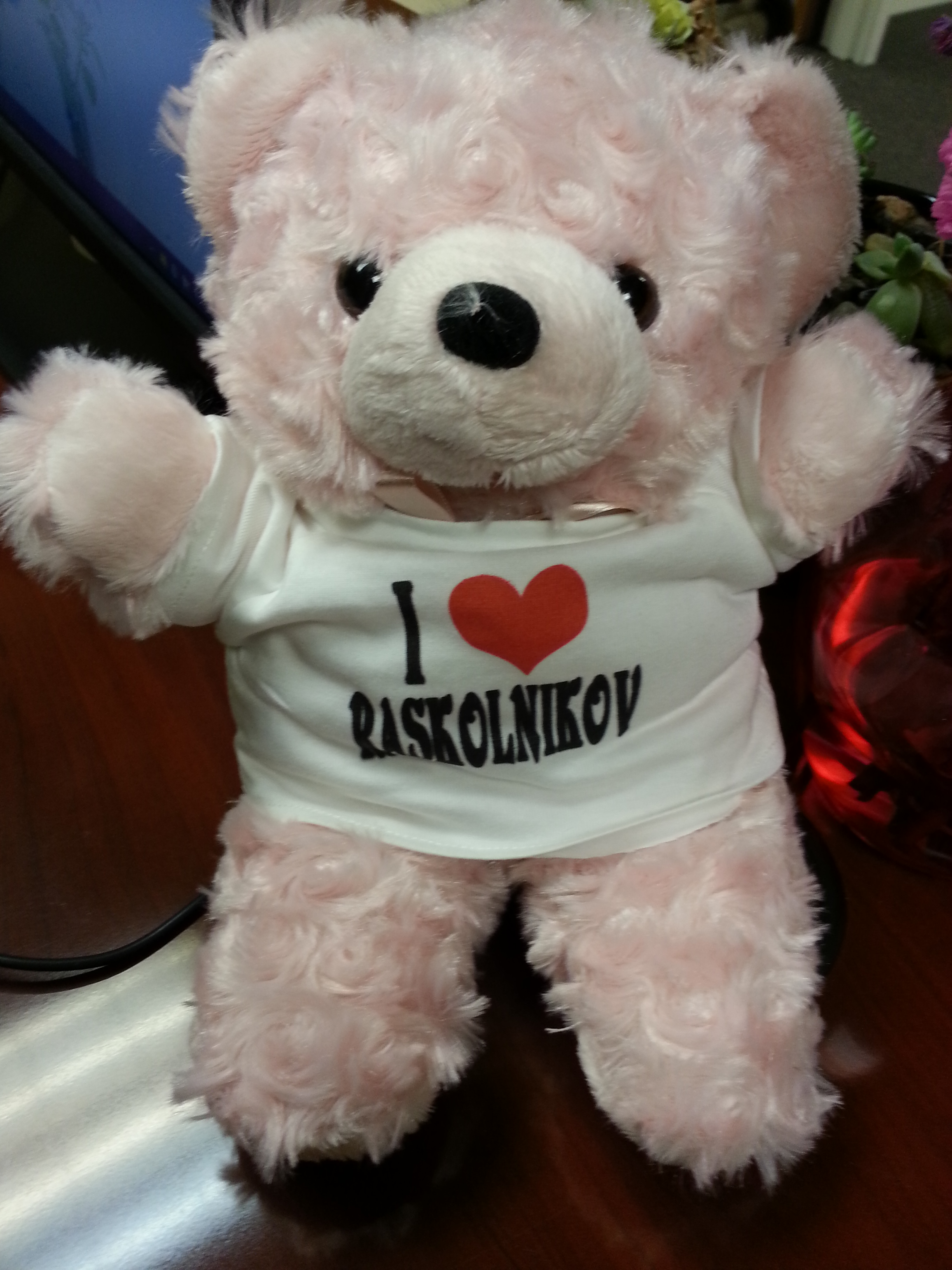
Spoiler Alert: Dostoyevsky’s Poor Folk is About Poor Folks Who Talk About Being Poor

But cookie cutter poor folk they are not. They are well-spoken and complex. Nonetheless, this book has been a snoozefest. And you know how I feel about Dostoyevsky. (If you don’t know, refer to a series of posts celebrating every single moment of Crime and Punishment. Beware: it’s literary fangirling to the extreme.)

So here’s Poor Folk. Pen pals/distant cousins Makar Dievushkin and Barbara Dobroselova are involved an awkwardly one-sided May-December relationship.  December’s Dievushkin constantly sends his love to May’s Dobroselova–but not like that, he emphasizes. He loves her like a daughter. A sexy, sexy daughter. Have some bon bons! (This is paraphrased, clearly–I don’t possess anything like the powers of lyrical and subtle prose of my beloved Dostoyevsky. Speaking of which, Dostoyevsky and I are involved in the ultimate May-December unrequited romance. In this case, it’s May that loves, and December died 100 years before May was born.)

I have to be honest. I’m not really in a good position to give this book the same kind of analysis I’ve given many others because I’ve been in skim mode since about 50% in. The writing is beautiful, so I’ve just been kind of soaking it in without processing much of the message. It strikes me as kind of a shame because it seems like this book meant so much when it was published. It was well-received, and it was considered a much-needed, sensitive, humanistic look at poverty. The author of the blog “Read, Write, Now” (who does a much better job of explaining this book that I do here, including why it’s second-tier Dostoyevsky) says, “Dostoevsky gives “Poor Folk” the human dignity to participate in the process of their own damnation.” I see that, but only after it was pointed out to me. I just can’t find much value on my own. Perhaps I’m just not in the right state of mind.

Or maybe it’s because I find both the characters annoying as all get out, and the plot (with the exception of the mini-autobiography recounting Dobroselova’s teenage years) is…well, there isn’t really one. There’s just the same message back and forth. I love you. I’m so poor. But it’s not so bad. But, man, I’m poor. I would do anything for you. I would give my last penny for you. In fact, here’s my last penny. Don’t feel guilty about that, though. Did I mention I’m really poor? But don’t worry, it’s not so bad. Actually, it’s terrible.

ad infinitum.

It’s my opinion that both of these people are codependent and manipulative. And I can only read the same codependent and manipulative message over and over before I zone out. There has to be more movement, more character development than this for me to stay engaged.

I hear echoes of the beauty of Crime and Punishment and Notes from the Underground  in Poor Folk. There is the psychological element, and clearly there is the frank, empathetic portrayal of suffering I find so compelling underneath the sentences I’m reading. But it’s buried too deep under endless, lovely-but-repetitive words. The rawness of later works goes missing in this first one.

I’m sorry, Dostoyevsky. I’m sorry, my love. But I don’t think I can finish this one. But don’t feel bad. Well, feel kind of bad. And have some bon bons.

Ella Minnow Pea–Surprisingly Serious

I forgot my current read (Mary Roach’s charmingly macabre work of nonfiction, Stiff,) at home this weekend, but there’s always the Kindle app on the phone to get me through. I had recently downloaded a book under blinder circumstances than usual: I had never heard of the title (Ella Minnow Pea) or the author (Mark Dunn). But a friend–the brilliant editor-in-chief of local art and lit journal East on Central–had recommended it, and I know her to have excellent taste.

She described the plot a bit to me, and it seemed like a fun curiosity. In essence, the book sounded like a written experiment in literary constraints, akin to Oulipo darling Georges Perec’s A Void. (or, in his native tongue, La Disparition. But the literal English translation of the French title, The Disappearance, would not do–the entire book is written without a single use of the letter ‘e.’)

Ella Minnow Pea (sing it out loud with me…q, r, s…t, u, v) is likewise a book about literary constraints and is likewise adorably titled. It takes place on a fictional island that reveres the inventor of the sentence “the quick brown fox jumps over the lazy dog” and has built a monument with lettered tiles spelling out his masterpiece. But the monument is old. One by one, the letters from the sentence begin to fall. In response, the government forbids use of the letters, believing the sentence-writer is speaking from beyond the grave.

The author tells the story through the townsfolk’s written correspondence, so he uses increasingly fewer letters of the alphabet as the book progresses. Cute, right?

Then there’s the cover.

EllaMinnowPea

See? Awww. Don’t you want to pinch its little cheeks?

Folks, this book is not cute. It’s an Orwellian allegory.

It’s about the inquisition. It’s about free speech. It’s about the crusades. It’s about McCarthyism. It’s about what happens when superstition trumps science. But I think it’s mostly about the power of language and what happens when it’s taken away—about the human need to connect with one another and how vital written and verbal communication is to that connection.

In the book, a people living on a separatist island of the U.S. coast have founded a whole culture based on letters. Consequently, they all toss around these unconventionally eloquent turns of phrase–their speech patterns are swirling loops of lovely. Their writing is a delight to consume. All you learn of the island, you learn directly from its inhabitants, as the author chooses to convey the plot of his novel solely through the letters written by characters to one another. (And by “letters,” I mean “missives,” “notes,” “emails but with pens,” etc. It’s poignant, in the context of the book, that the word “letters” can mean two different things and that both are so significant in the novel. But, boy, does it make it difficult to write a clear blog post about the book.) As mail becomes subject to government inspection, and the use of, um, alphabetical characters becomes removed bit by bit from the vocabulary of the inhabitants of the island, the reader can see these elegant people reduced to baby talk. Yet they never stop trying to communicate, even when their usable alphabet consist of letters you can count on one hand. And hats off to the author who insists on playing by the rules of his own game–on living this struggle to communicate, along with his characters.

This book isn’t just play, the way some postmodern and otherwise experimental books are. The plot is solid, well-told, and deeply moving. The draconian measures taken against violators of the law remind the reader of all the shudder-inducing censorship and stripping of rights we’ve learned about from history (both our own in the U.S. and that of other nations/empires), and it reminds us of that which we hear of present totalitarian and theocratic states. The government of this island has declared itself the interpreter of god’s will, and the people in charge feel the execution of punishment justified, even holy. Neighbor turns in neighbor for using banned letters. Some do it to satisfy old grudges, and some honestly buy into the religious rhetoric. Even insurrection is discussed with increasingly limited language, and communication is reduced to nonsense. The names of days and months become downright comical.

The book has a good ending, and I won’t say any more about it than that. I will say that it’s a great read for many reasons:

1. It’s entertaining. I read it in an afternoon easily, and I couldn’t put it down.

2. The author is an excellent writer. He himself has a grasp on the English language that’s just breathtaking to read. And he uses his self-imposed constrains to develop an empathy with his characters that shows. He manages to communicate clearly, elegantly, and cleverly the entire way through, even while showing the struggle to communicate.

3. The commentary on superstition, tyranny, censorship and our need for language is just stellar.

4. It’s not one bit cute. That’s a great deal for me. If I want cute, I’ll do an image search for baby bunnies: I’m not really looking for cute in my books.

One final though—find your reading soulmates and have them recommend books. You’ll have a steady supply of custom delights that you would have never discovered on your own.

Discussion Questions/Food for Thought to Help Understand Crime and Punishment

So (as I’m sure I’ve made it abundantly clear over the last few weeks) Crime and Punishment is my absolute favorite book. As I’ve said before, it’s my bellweather. It’s helped me define what literature is to me, and it’s a big–maybe the main–reason I love literature enough to have made it my major.

That being said, I don’t think it’s an easy read. And I don’t think it will, or even should, be everyone else’s favorite book. My tastes can run morbid, and I value characters and psychology much more than I value plot. I know this.

I also know that everyone has different preferences. And I know there are several blockades that make this book less accessible then most people’s regular reads, such as language difficulties due to century of publication and unfamiliar customs/naming conventions (unless you’re Russian, of course).

But I think, with guidance, everyone can appreciate what Crime and Punishment brings to the table. You can understand why it’s stuck around this long, and you can have some really, really great conversations about it with interesting people. You don’t have to like it as much as I do, but I think I can help you extract value from reading it.

Questions coming up. First, the most important thing to making Crime and Punishment more accessible: keeping track of who’s who.

Russian Naming Conventions

It’s really hard to keep who’s who straight because everyone has at least four names (well, in the sense that us Anglofolk have two or three names–a first, a last, and possibly a nickname). And Russians have seemingly endless combinations of those names.

I can’t recommend this enough: say the characters’ names aloud in your head. Like, sound them out, syllable by syllable. It really helps keep them straight in your head.

Svidrigailov.

Svid.

Drih.

GUY.

Loff.

(That’s kind of a cool name.)

Also, this (adapted and then quoted from a U Virginia site) will help you understand the names better:

Rodion Romanovich Raskolnikov

Rodion = first name

Romanovich = patronymic

Raskolnikov = family name 

Russian names generally consist the three parts: the first or given name, the patronymic, and the last or family name. The patryonymic is created by taking the given name of a person’s father and adding a suffix to it. This suffix means “son of” or “daughter of.” Thus the patronymic takes a different form for men than it does for women. The most common men’s suffixes are -ovich or -evich while for a woman they are -ovna or -evna.

Russians call each other by first name and patronymic. Often, however, Russians will use a shortened form of the first name, a diminutive that connotes more familiarity. Often friends and children will be addressed in this way. One can think of the patronymic and name being equivalent to “Mr. So and So” in our culture.

So calling Raskolnikov “Rodion Romanovich” is like calling him “Mr. Raskolnikov” in the English-speaking world. His dad’s name is Roman. So his sister, who is most often called Dounia, has the patronym “Romanova” as a female version of the dad’s name. But a person not close to her would call her by her non-nickname first name and patronymic, Avdotya Romanova.

Women are never called by their last name. For instance, Dounia isn’t who we think of when we say Raskolnikov, but that’s her last name as well. So Katarina Marmeladov is (obviously) a Marmeladov, but when “Marmeladov” is mentioned as a character in the book, it’s a reference to the patriarch.

Now…

Questions to consider while reading Crime and Punishment

There are no cut-and-dry answers to these questions, which, in my mind, is what makes the book so great.

*Note: I consider these questions spoiler-free, unless you consider the murder of the pawnbroker a spoiler. If you’re picking up Crime and Punishment and you don’t know the main character is going to kill a pawnbroker…um, sorry for that. You would have figured it out pretty soon, though. I promise.

1. This is my favorite question, so it’s going first on the list.

Raskolnikov gives a number of reasons throughout the novel for killing the pawnbroker, especially when he goes to visit Sonia the second time. Some of them are clearly just not true. Others are more plausible. The one most often believed is his idea that he is somehow the embodiment of Nietzsche’s idea of the ubermench, or superman, who is above the common man and therefore need not abide by their rules. If you believe this, then Raskolnikov killed to prove to himself that he was, indeed, above the common man and would not suffer their common consequence, including guilt or remorse. Do you think that’s the real reason? What evidence would you give for what you think?

2. Does the guilt Raskolnikov feels manifest itself in ways you imagine guilt would? Is it guilt that he is experiencing, or is it something else? If it is guilt, why was he so disturbed before the murder as well? Was the thought of killing tearing him apart, or is he mentally unbalanced in a different way?

3. I would argue that 90 percent of the characters in the novel are delusional. Raskolnikov has literal delusions in the form of hallucinations, but he also holds broader, more philosophical delusions. Katerina has delusions. Raskolnikov’s mother certainly has delusions. Think of Sonia. Svidrigailov. Razumihin. What is each character’s particular delusion? What role does the delusion play in helping them cope or destroying them? Are any of the delusions healthy?

4. Think about Raskolnikov’s dream of the horse and the way he spends his money. Is Raskolnikov a compassionate person? Or is simply ruled by impulses that swing more wildly than those of most people? Is it too complicated a question to answer?

5. Does Raskolnikov seek absolution or credit for what he did? Both?

6. Both the pawnbroker and her innocent, good-hearted sister are murdered. One might think that the focus of the novel would be on the death of the innocent woman, and that this would be the murder that troubles Raskolnikov the most. Yet, she seems not to be the focal point at all.  Why is Raskolnikov’s guilt and the murder of the pawnbroker such that the sister is just a byproduct, not the true tragedy?

Here’s the real question: is it important to the novel that Raskolnikov feels the way he feels after killing a pretty awful person that did more harm than good?

7. If you were going to argue that Raskolnikov was a good person, what would you use as evidence?

If you were going to argue Raskolnikov was a bad person, what would you use as evidence?

What does it mean that you could make a good argument for either side?

8. Svidrigailov. Is he evil? Are you glad when he is no longer in the picture? If not, why? Either way, why do you think he departs from the novel the way he does?

9. It’s tempting to think this a story about redemption through suffering, especially by the end–a very Christian theme indeed. The most religion-focused family is the Marmeladov family. There’s Katerina’s blasphemous rejection of it near the end, Sonia’s embrace of it, Marmeladov’s love of his righteous punishment, almost like self-flagellation (and his “confession” to Raskolnikov in the bar in beginning of the book). Does anyone have the right of it? Do any of them wind up the better for it?

10. Do you find the ending–either the non-epilogue or epilogue version–satisfying? Was there a better way to end it? Does anything remain unresolved, in your mind?

11. What do you think of the women in the novel? Why are they all so self-sacrificial? Do you think it’s cultural, or do you think it says something about the author?

12. Would you argue that Raskolnikov would be in a different state of mind and would have perhaps chosen another path if he were less broken by poverty, hunger, and illness? Or is it simply his personality that makes him who he is? Any evidence for your reasoning?

These are just a few of the things I like to contemplate as I read. There’s so many more questions worth exploring. But I hope this gives you a launching pad and that wondering about these questions along with me makes your experience reading Crime and Punishment more meaningful.

Crime and Punishment: Svidrigailov as Raskolnikov’s (Rich) Doppleganger

I’ve finished Crime and Punishment, and I’m more certain than ever that Svidrigailov is what Raskolnikov would be if he’d been born into different circumstances. Well, let me qualify–the two are hardly twins in their core values, and their social personas are quite different. But their nature is composed of the same stuff, I think.

Yes, Svidrigailov disgusts Raskolnikov. Notice Dounia and Raskolnikov are both extremely chaste and seem fairly scandalized by anything that has to do with sex. So in this sense, Svidrigailov and Raskolnikov are nothing alike. But by the time that he and Svidrigailov meet in the pub (their last interaction), Raskolnikov knows that he doesn’t have much moral high ground. His former hope that he is an exceptional person is unfounded, and he knows it. So Raskolnikov calls Svidrigailov base due to his disgust for Svidrigailov’s particular vice. But Raskolnikov has his own vices–pride, indulgence of sadism, etc.

And, really, think of the interactions that go on in Sonia and Svidrigailov’s building. Svidrigailov makes it quite clear that Dounia is completely at his mercy. In fact, he comes right out and declares his intent to assault her then and there, noting that his physical strength is much greater than hers. It’s certainly true that Raskolnikov would never do anything of that sort. But think of the way he treats Sonia in her room. Doesn’t he seem to come there just remind her how helpless she is? Make her feel trapped? Doesn’t he come to there outrage and horrify her?

And as hostile as we might feel toward Svidrigailov due to the nature of his threats, consider this–all Svidrigailov’s anecdotes point to his psychological power to seduce. He knows exactly what his target is thinking, he understands what governs their behavior, and he knows how to manipulate people. During the bar conversation, Svidrigailov claims to have had a woman completely convinced that she was innocent of any wrongdoing throughout an affair, only to tell her afterward that he believed her to be just as eager as he. Now, Dounia couldn’t sacrifice her purity willingly–he knows that she is too chaste. And he truly believed that they had shared some kind of chemistry back when she was his governess. What Svidrigailov was doing was attempting to seduce Dounia by giving her a way out, a guilt-free way to give in to her feelings for him without hating herself. When Svidrigailov saw from the look in her eyes that she was completely cold to him, he quickly let her go on her way. He’s never wanted to have any woman against her will, and especially not Dounia. He gets off on consent. He likes to manipulate his way there, true, but he wants to be wanted back.

And I think that Svidrigailov felt differently toward Dounia than he did toward other extramarital prospects, I really do. I mean…

PAUSE FOR SPOILER ALERT. Do not read on if you aren’t finished with the book.

+

+

+

+

+
…he does kill himself afterwards, and how many other women have there been and could there be int the future? Dounia was special. (I think there was another reason he killed himself as well, since he showed his suicidal intent before being rejected by Dounia. But I’m just saying. He doesn’t do it until after seeing if she’ll have him.) Just as Raskolnikov is not as bad at heart as he seems, neither is Svidrigailov. It’s proven in other ways, too.

Think of Svidrigailov’s last night. If Raskolnikov was rich, couldn’t you see him doing the same thing? Giving away everything he had, spending a feverish night dreaming of children with lost innocence, hallucinating that he is helping people only to find them turning on him…tell me that isn’t Raskolnikov through and through.

The difference is that Svidrigailov is bored. He can afford to be bored because he is comfortable. He’s past his more youthful days where he might be more inclined to brood, rage against the system and try to find his identity through testing theories. And he wasn’t starving and sick. Imagine Raskolnikov growing up more comfortable than he is, marrying into wealth, and trying to adjust to life from there. He’s not much inclined toward sensuality, but surely he’d become lost in another passion in order to keep himself from dying of sheer boredom. It’s a world with too little to offer such a mind. Svidrigailov is terminally bored. He says so several times. And he doesn’t really care for the money. He just gives it all away. I think Svidrigailov is just what Raskolnikov would have become if he had developed under different circumstances and was fifteen years older. He’s maybe not the mirror image, but it’s hard to ignore the similarities.

Crime and Punishment: The One Against Whom Raskolnikov Has No Chance

Porfiry, Part II!

You know, I think Raskolnikov could have gotten away just fine with fainting at the police station. That wasn’t what started it all, as far as the police suspecting him. He’s clearly sick and weak when he goes to the station (and perhaps even a little off his rocker, one might assume).

If you’ve read the book, you know that Raskolnikov does a number of things throughout the book that make you scream, “Why!? Why are you saying this? No one suspects you!” And that, in itself, is another discussion*. But there was one big, initial mistake that really doomed him, as far as getting caught. And it wasn’t fainting at the police station.

That big mistake was his ridiculously ill-advised discussion with Zametov in the restaurant. Raskolnikov purposely steers the conversation toward the police blotter (or whatever the 19th-century Russian equivalent to the police blotter is). He proceeds to makes Zametov very uneasy, forcing his companion to consider the possibility that the murderer sits before him. But this isn’t a big mistake because it made Zametov suspect Raskolnikov. Zametov isn’t really a very good detective. He’s too young and too easily shaken, and he doesn’t trust himself. He very easily could have convinced himself that Raskolnikov was just in need of serious mental and physical help. After all, what guilty person would ever act like that? That’s the talk of a crazy, not a criminal.

No, the problem with that conversation with Zametov is that Zametov was shaken enough to tell Porfiry about it, and Porfiry knew instantly that Raskolnikov was likely to be his man. Once that conversation with Zametov was relayed, it was just a matter of finding evidence. Porfiry, unlike Zametov, is psychologically brilliant, both in perception and in manipulation. He is seasoned and perceptive enough to have taken note of Raskolnikov’s article some time ago and filed away the author’s name in his memory, considering him someone from whom he’s not heard the last. Porfiry can tell just from the article what kind of person Raskolnikov is and what he might do to prove himself worthy of his own words.

Porfiry loves his job. I think he has a barrel of laughs catching people in his web (and I think the references to spiders throughout the book supports this nicely). But I don’t think he’s sadistic. He’s just a chess player. He enjoys the competition, he enjoys figuring out his opponent, and he loves winning. But he sees his opponents as people. While Porfiry was rather cruel, deliberately torturing Raskolnikov in their first few encounters (one at Porfiry’s house, one at the police station), the third encounter at Raskolnikov’s apartment proves that he finds Raskolnikov quite interesting, and he doesn’t want Raskolnikov’s life to be ruined by what he did. That being said, Porfiry still wants to win, and he will do what he needs to in order to be the victor. And frankly, Raskolnikov is smart, but he never had a chance against Porfiry. Even at his full strength and mental capacity, Raskolnikov is too young to have really sorted out a way to deal with life, and especially with other people. He’s plagued by the need to develop theories about where he stands in relation to others and how to divide folks into hierarchies. At the core of his struggle is how to reconcile the age-old question of why bad things happen to good people. Porfiry, no matter his age, is decades ahead of Raskolnikov in his maturity, adjustment, and view of human beings.

Young people want to fight the system. As people get older, they become more interested in how to rise within or above the system instead of focusing on rejecting it entirely. Raskolnikov and Porfiry are both smart, but Porfiry wins every time in this contest.

* Ah yes, I haven’t forgotten–why does Raskolnikov continually bring himself into conversation about the murder when he could just as easily say nothing or change the subject? When no one suspects him, why does he routinely demand that people suspect him, despite his terror of being caught? There’s probably a million theories you could come up with, and I’d be delighted to hear other people’s take on this.

My own tendencies influence my thoughts on this. I’m reminded of a time I was in the car with someone, and I was doing something–drawing money out of a drive-up ATM or something. On the way out, I very slowly, and one might have though deliberately, coasted right into a mailbox. I was looking right ahead of me and I have no idea how it’s even possible for any human being to do something this dumb. (The mailbox was fine, by the way.)  I nearly died of embarrassment. I made the person in the car to swear never, never to tell anyone.

Then, the next day, I went out of my way to tell pretty much every person I knew about it.

Why did I do that? God, I don’t know. I do things like this all the time–every time I do anything I’m embarrassed about, I go out of my way to make sure everyone knows. It’s as if seeking out enough people to make fun of me diffuses the embarrassment, takes away some of its power. It’s threatening force as a terrible, shameful secret disappears. Maybe Raskolnikov cannot help but try to relieve the pressure of that swelling threat by leaking bits of his secret, conversation by conversation.

Crime and Punishment: Porfiry’s Ace in the Hole

First off, look at this.

20140725_080415

If going on for eternity about Crime and Punishment is going to earn me magical gifts like this, I’m going back to posting per chapter.

I’m at the point in the book where Porfiry, the main detective in Crime and Punishment, has come to Raskolnikov’s room and flat out declares that Raskolnikov is the murderer. That he declares it as fact is important; he does not claim that he suspects it or that he is convinced of it. Porfiry’s own opinion does not matter, because it isn’t a suspicion. It’s simply the truth, to him. And, of course, he’s right. He gives Raskolnikov a few days to turn himself in to make it easier on himself because—and I think he’s being honest here–Porfiry claims to rather like Raskolnikov. He’s not in the least like Javert, the detective from Les Miserables, who believes so fully in good, evil, and clear-cut rules of justice that he cannot handle it when shades of gray are revealed. Porfiry knows that people are complicated. He knows Raskolnikov is more mentally unsetteled and broken than he is evil. And I think the detective feels sorry for him, in a detached sort of way. Nonetheless, the murderer must be convicted and serve his sentence.

Porfiry claims to have evidence but that he’d rather not be forced to use it. I can’t remember if this proof is revealed by the end. I’ll have to come back and adjust my thinking if this turns out to be wrong. But if I remember correctly, we never concretely learn what Porfiry’s ace in the hole is.

Of course, it could be a tactic. It would be more likely that Raskolnikov would confess and the case could be closed if he was pressured to do so by evidence, and whether or not the evidence existed would be ancillary if all Porfiry was aiming for was a conviction. But Porfiry, during this encounter, is quite blunt with Raskolnikov.  He admits to not knowing where Raskolnikov’s buried the stolen items, which I doubt he would do if he was bluffing. (That would likely be some of the best evidence of all, considering the stupid conversation with Zametov where Raskolnikov stated how he would hide the goods if he were the murderer.) And, after reading the chapter, I think I know what the evidence is. It’s confusing. But I can’t see any other way.

During this encounter, Porfiry drops several phrases that are exact references to past conversations Raskolnikov has had with other people. He talks about “taking his suffering”–an odd turn of phrase for someone who can see clearly that Raskolnikov is already suffering enough and who does not, I think, believe in the religious value of suffering for sins. Porfiry has echoed Sonia’s words exactly, and in the same context explains redemption through confession. It’s quite inconsistent with Porfiry’s character, and the exact turn of phrase repeated seems an unlikely coincidence. If there were better technology back in those days, I’d have said Sonia’s room was bugged. But since that’s impossible, that means Porfiry’s evidence is likely a witnesses to this conversation, of which there are two: Sonia, and the metaphorical-popcorn-eating eavesdropper next door, Svidrigailov. The next hint tells us which of the two is the source of the evidence.

Porfiry also quotes the exact advice Svidrigailov gives Raskolnikov about fresh air. It’s eerie, and that phrase never passed between Sonia and Raskolnikov. So Svidrigailov has to be the man–he must have talked to Porfiry already about the conversation, or he is otherwise the source of what Porfiry knows.

It’s so hard to see either of them talking to Porfiry. On Sonia’s end, what redemption can their be for Raskolnikov’s soul if he goes to his suffering unwillingly? And Raskolnikov himself seems convinced there’s no way Svidrigailov has talked, and it’s hard not to agree. One, it doesn’t seem to be in his character. Two, what has he to hold over Dounia’s head if he has already talked to the police on the matter?

Porfiry definitely has heard conversations that have passed between Raskolnikov, Svidrigailov, and Sonia. How he got wind of those conversations…it’s hard to tell. Perhaps he’s done some eavesdropping of his own.

More about Porfiry in another post. He’s a rare intellect and a very interesting character. Raskolnikov’s biggest mistake was ever getting on such a man’s radar, if we’re talking purely in terms of getting caught.

Crime and Punishment: Svidrigailov as Raskolnikov’s Doppleganger

Well, I’m far beyond posting for every chapter now. I am exactly 62% through the book (the glory of having a Kindle is that I know this) and I am disheartened; there’s now so much I want to say that I’m not even sure where to begin.  So before I get into my main topic, just a few updates on wrong assumptions.

1. I don’t think Raskolnikov’s mother is manipulative after all. I think that, if we can trust anyone, we can trust the omniscient narrator. These are the facts that Dostoyevsky wants to share with us about his plot.  And omniscience says that Pulcheria “had only that morning thought rupture with Luzhin a terrible misfortune” before the family gives him the boot at dinner.  So Pulcheria, I believe, really is just a hand-wringing babbler who wears her heart on her sleeve. She did, in fact want the marriage to Luzhin to happen.

2. The reoccurring theme of power vs powerlessness manifests itself with the discussion in Sonia’s room.  Raskolnikov fluctuates wildly, first bowing to all the suffering of humanity/kissing Sonia’s feet and then scorning her immense sacrifices, which provide no real solution at all to her family’s problems. Sonia is still unable to alter her family’s destiny, and Raskolnikov rubs her helplessness in her face. Once again, it’s the pull of two Raskolnikovs–one that wants to give every last penny away as he starves (like Sonia) and one that is like his father that advises avoiding trying to help others because, well, what can he do? Indeed, what can Sonia do?

3. I was wrong in assuming the men in the bar just planted the thought of murdering with the excuse of justice in Raskolnikov’s brain. I had forgotten about one of the most important parts of Crime and Punishment: Raskolnikov’s article that was of such interest to Porfiry. Raskolnikov had the idea of justified killing far before it was suggested at that bar, so it really was as if circumstance was eerily setting up the murder of the pawnbroker and poor Lizaveta. Oh, I have so much to say about that article he wrote…oh well, another time.

And now for the topic at hand: Raskolnikov’s rather sinister but more suave twin, Svidrigailov.

The first time I read this book, I thought Svidrigailov was pure evil. I especially thought that after the rather dramatic scene with Dounia near the end. He was conniving, devious, a little rapey, terrifying…what isn’t pointing to evil? But every re-read, I have liked Svidrigailov more and more (and Luzhin less and less). Certainly I’d noticed that Svidrigailov had said he and Raskolnikov were alike before, but only this time do I realize how right he his.

The way Raskolnikov reacts to Svidrigailov when they first speak is quite like how others react to Raskolnikov (specifically, “He is a madman” and “‘You are certainly mad'”). Svidrigailov has the same awkward laughter, as if he has inside jokes with himself. He daydreams aloud without thinking, alarming those around him (think of Raskolnikov scaring off the friendly stranger after handing money to the young girl singing at the market).  He’s significantly introspective and forces people into conversations that make them uncomfortable.  He believes he sees ghosts, just as Raskolnikov sees things in delirium. He speaks of being ill, and he imagines that eternity might be one little corner filled with spiders (this tiny space to inhabit is a reoccurring theme in Raskolnikov’s thoughts, though the spiders seem to be lacking in his version, thankfully). Raskolnikov cries about the justice of Svidrigailov’s described eternity, but really only one manifestation of Raskolnikov is concerned with justice–the little boy that wants to kiss the dead horse and come to blows with its owner. The other manifestation of Raskolnikov believes Sonia’s stepsiblings will be left helpless and all her sacrifices will be for nothing, and he has no trouble confronting the injustice head on. This version of Raskolnikov, to me, sounds very much like the cynic who would picture a corner of eternity with spiders.

Svidrigailov “rarely lies,” and he’s so blunt I’m prepared to believe him. Think of the sentence “‘What do I mean? I really don’t know…’ Svidrigailov muttered ingenuously, as though he, too, were puzzled.” 1. It’s quite clear that he is honest, and perhaps too muddled in the brain to be otherwise, and 2. wow, how easily could that line be coming from Raskolnikov? But, while being honest, Svidrigailov avoids full disclosure.  He must. So his speech is full of phrases that he knows bear a heavy significance to him and him only, and, understanding others cannot know what is in his mind, he playfully hints at a larger picture. An example of this is Svidrigailov’s abstractly described “journey” (proving, in my mind, he has planned to kill himself before even getting to St. Petersburg).  Raskolnikov does this constantly as well–he loves to talk about the murder with people and chuckle and hint at things of great significance, but only for his own personal enjoyment–or masochism.

His own enjoyment or masochism. That’s the clincher. That’s why Svidrigailov and Raskolnikov are the most alike.  And it’s why I think I like Svidrigailov no matter what a knave he is. They never bother to think about what others think of them. They simply do not care an iota. They’re so lost in their own psyche that other people only play a fringe role. Sure, Raskolnikov cares if the police know what he’s done–when they’re around, and only because it concerns his future.  What he never thought of until recently in the book is what Razumihin will think when he finds out. And Razumihin has furiously defended Raskolnikov throughout the book, so it’s rather a surprise to think Raskolnikov never had a moment of “if only you knew!” Likewise, Svidrigailov says “I am certainly idle and depraved” and makes no apology for it or show any concern that Raskolnikov thinks it. In fact, he plainly says, “I am not particularly interested in anyone’s opinion” when Raskolnikov talks about how others view him, and from the bluntness of the entire conversation, it’s hard for me to think he isn’t telling the truth.

For someone trying prove he is Napoleon, Raskolnikov sure cares little about how others see him. He is possible the least self-conscious character I’ve read, at least as far as his awareness of how he comes off to others and his concern as such. It’s all about proving his thoughts internally harmonious–with proving himself to himself. He is the opposite of Luzhin, seeking affirmation and flattery everywhere he goes. So Svidrigailov is the opposite of Luzhin, too. It’s what I like about Raskolnikov and Svidrigailov–in that way, as well as others, they are very alike.

Crime and Punishment: Power vs Helplessness

Consider with me the contents of chapters four and five of Crime and Punishment. (See, I’m not going to do a post per chapter after all.)

Short summary: Raskolnikov goes wandering and musing, as he is apt to do. He thinks about his mother’s letter and of his murderous plans and becomes extremely upset, as he is apt to become. He then sees a young girl with her clothes torn, completely drunk and unaware of her surroundings, and he perceives that a man following her has designs on her in this state. Raskolnikov attacks the man, determined to save this young girl from any further trauma, and he gives a policeman a great deal of his remaining money to get her a ride home. Then, as quickly as it came, his sympathy dissolves and he laughingly tells the policeman to just let the man do as he will. No use interfering with fate. The policeman thinks he’s crazy. He’s probably right.

Raskolnikov falls asleep in the bushes and has a terrible dream about being a child walking with his father and watching a helpless old horse be beat to death. It’s one of the worst parts of the book, but it’s so important. Then he walks home, swearing off all murderous thoughts and feeling better for having made the decision. He takes a long route home and stumbles upon the pawnbroker’s sister, Lizaveta, in conversation. He learns Lizaveta will be away from the house tomorrow evening, and he, in despair, decides this opportunity to catch the pawnbroker alone means that his fate is sealed. He must kill the old woman.

End summary.

Here come the contradictions that make Raskolnikov so human and so interesting. He believes that, if he doesn’t make a decision about the murder, he must resign himself to an entire life of helplessness. “He must decide on something, or else…’Or throw up life altogether!’ he cried, suddenly in a frenzy–‘accept one’s lot humbly, as it is, once and for all…'” Raskolnikov will later claim that the murder was an assertion of power, an expression of his supremacy and control.  Yet, when he makes a decision in chapter five–a decision not to kill–it seems to him as though fate then takes away this ability to make decisions and assert his agency. Killing the pawnbroker means powerlessness to Raskolnikov in this moment, not power.

After he decided to renounce his “dream,” as he calls it, of killing the pawnbroker, his meanderings bring him through the haymarket, which he claims to like to visit. Despite that the chapter gives a reason for him to be there–he likes it there–he thinks of the detour from the route home as a cruel magnetic pull of fate and nothing else. To him, it is as if some bizarre circumstance for which no one could possibly account cursed him and sent him to that place, sealing his future actions without his permission. Dostoyevsky says Raskolnikov felt “superstitiously impressed” that this route was the “predestined turning point of his fate,” and it was “as though it had been lying in wait for him on purpose.” He hears of Lizaveta’s impending absence and “he felt suddenly in his whole being that he had no more freedom of thought, no will, and that everything was suddenly and irrevocably decided.”

It’s strange because it takes much more choice to actually go out and kill someone, or even to take a different route home because you like the area.  Yet these are the things that strip Raskolnikov of his feelings of agency. Deciding to take no action against the pawnbroker–to let fate decide her path and to not intervene–made Raskolnikov feel free. After dreaming of the horse’s violent death and hearing his father say “it’s not our business” and encouraging Raskolnikov to take no action, you would think that it would be the opposite–that it would be action that gave Raskolnikov relief. He could certainly (outwardly) justify killing the pawnbroker. Doesn’t she act as a symbol of all the abusive and greedy monsters Raskolnikov has encountered in life? Isn’t she like the fat woman, rich and gluttonous, cracking nuts and laughing as the poor horse is struck with an axe? (Well, no, but that’s another post. I’m saying he could certainly convince himself that this is righteous vigilantism.)

He has such intense bouts of empathy for others, and he very much wants to intervene. The situation with the young girl and the horse are completely parallel. Something helpless is in trouble and Raskolnikov will do anything for them: fight for them, give them every last penny. In his dream, his father encourages him not to interfere in these injustices. With the young girl, you can almost see the father figure rise up and overcome child-Raskolnikov as he turns 180 degrees, claiming no one should intervene–it isn’t anyone’s business what happens but the girl’s and her stalker’s.

What Raskolnikov seeks is power, but all he sees–and some of this is probably self-imposed martyrdom–is his helplessness at every turn. This is Raskolnikov’s struggle. He wants to do something good in a world that makes him feel powerless to do good. Or he wants to at least avoid the pain of trying to change things and being helpless to make a difference. He can’t make either one happen.

Crime and Punishment: Raskolnikov’s Mother

Chapter three. It continues.

I had always thought of Raskolnikov’s mother as simply sincere, sentimental (to a fault), and a little batty. But after reading her letter to Raskolnikov, I’ve decided to explore a new theory and see how much water it holds for the rest of the novel.

Perhaps Raskolnikov’s mother is more deliberate than I’ve given her credit to be. In her letter, she describes an existence where Dounia and she are constantly thinking of him and would do anything for him–in fact, everything they currently do is for him.  She seems so much in earnest, to the point of blathering, in her letter, so it seems like an outpouring of love. But for the first time, I’m entertaining the idea that Raskolnikov is not her favorite child after all.  That puts quite a different spin on things.

Her is the narrative of the letter in one light–the light in which I’ve always read the letter in before:

  • I haven’t written because I couldn’t–you would come marching up here with guns blazing to defend your sister*
  • Dounia has undergone terrible suffering and slander but now everything is going to be great!
  • Her future husband will take care of the whole family, get you a job, etc. He’s kinda pompous, but please don’t judge him–give him a chance, because all our hopes are with him, and I’m sure he’s really a great guy.
  • Heck, when they get married, maybe I’ll even try to strike out on my own! Me, an independent woman–picture that!

*Question: Would he have, though?  Would Raskolnikov have really come in a fury to defend Dounia’s honor? Maybe. He’s such a moody guy that I’d say it depends on the day.

Now, here is the narrative of the letter in a new light, reading between the lines:

  • I haven’t written because I couldn’t–you would come marching up here with guns blazing, or at least I’d like to make it clear that that’s my expectation of your character and I’m hoping you’ll take the hint and match those expectations, should future circumstances like this arrive and we need you.
  • Dounia has undergone terrible suffering, and it’s all for you, really.
  • She’s done all this and now she’s about to marry a self-important, insulting, disgusting person she doesn’t even like, and guess why–FOR YOU.
  • If you let her marry this guy for your own benefit, God have mercy on your soul.
  • Also, I don’t think that he’s going to make me feel welcome in their house and I’m too poor too make it alone

Does this new reading hold water? Well, I’ll look for it as I read on. But I noticed this time around that she says things she certainly knows will prejudice him against Luhzin (like “it did strike me as very rude,” or “Of course, there is no great love either on his side, or on hers…but Dounia…will make it her duty to make her husband happy,” or “it must be admitted the matter has been arranged in great haste,” or “he seems a little conceited”). And she certainly makes it clear that Dounia (her favorite, perhaps?) is making endless sacrifices for him (she isn’t sleeping, she’s in a fever over dreams of what this connection could mean for her brother, etc.).

I always thought that Raskolnikov’s mother was just overly chatty and says whatever comes into her mind without thinking to censor herself. But writing vs speaking is very different. Mom has a chance to really think about what she’s saying, and she can always throw out a paper on which she’s written things too hastily. She knows her son. She knows how he will read all the things she’s said, how he’ll interpret all of her words.

On a broader scale, this could be an author technique to prejudice the reader in certain ways as well, and I’m just being overly, umm, invested. Perhaps my initial reads of Mom are accurate. But I’m going to explore the manipulation angle this read-around, just for fun.