St. Lucy’s Home for Girls Raised by Wolves: Overview

So I read this collection of short stories in lieu of a 2012 winner. Yes, it is called St. Lucy’s Home for Girls Raised by Wolves, and yes there is a story about girls raised by wolves in there. It’s by Karen Russell, who was absurdly young when she assembled this. It has officially ruined my Pulitzer adventure.  Why? Now my Kindle is loaded with every Karen Russell book in preparation for my upcoming read-a-cation in the Caribbean. Forget my Pulitzers. I found my new favorite author.

This book was outrageously creative–fantastically quirky–but so stirring. It is wild and other-worldly, feral and foamy and vivid. Karen Russell is my age, and she makes me feel both years younger and years older than her.

Russian critic Viktor Shklovsky talks about defamiliarization being the key to good literature. In essence, those authors who can take the everyday and mundane and show it in a fascinating new way are those who succeed at their craft. It’s funny–I think what makes Russell so great is the mirror image of what Shklovsky says. She creates these mysterious, completely foreign worlds that are startling and disorienting, but she adds such a human vulnerability to them that they have a heart-aching resonance. She takes the unfamiliar and re-familiarizes you with it.

Have you ever seen an abstract piece of art that was not a recognizable reflection of the world we live in and yet pulled at something deep inside of you? Picasso’s Guernica is good for that. I know some people feel that way about Dali. Magritte does it for me…LaBelleCaptive
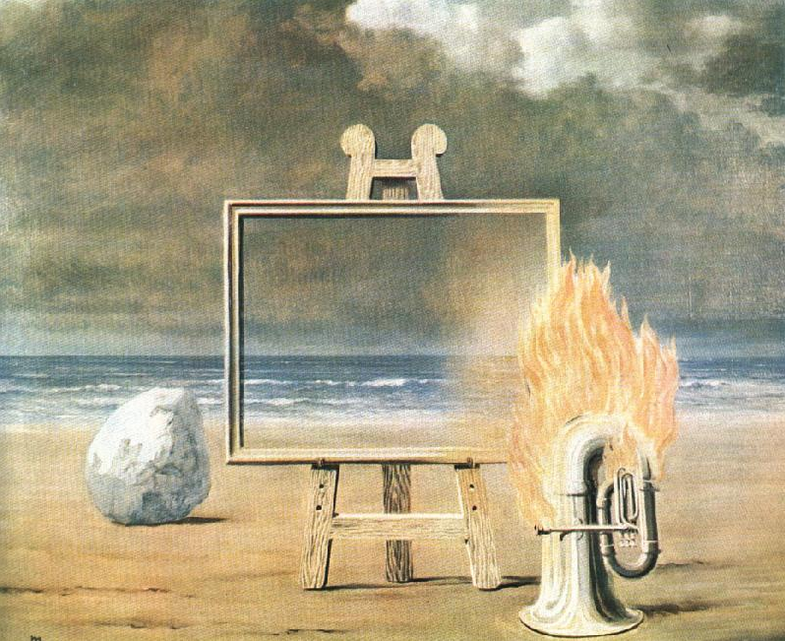
Russell’s story reminds me of these images. They themselves are kind of whimsical and kooky, but there’s a real element of sadness or striving or connection in it all–a familiarity in all the creative rainbow swirls and shards of surrealism. Anyway, this book. For real.

Tl; dr Synopsis

There are a series of ten very imaginative short stories, taking you places you only dream of but solidifying the details that would be fuzzy in your sleep. There are manufactured blizzards for adult playtime. There are minotaur/human families. There are sleep disorder camps and learn-how-not-to-be-a-wolf-child camps. There are giant shells set up like a tourist trap, seaside version of Stonehenge. There are communications with the phosphorescent ghosts of fish. It is outrageous but not confusing, because there’s always a very familiar human element keeping you grounded. The stories aren’t just nonsense. They’re meaningful. And they’re over way too quickly. Perhaps my only complaint is that every story left me wanting more and almost feeling cheated.

Writing Style

Vivid! Fast moving. Never stilted. Full of colors and flashes and metaphor. Easy to follow.  Almost as good as her stories, which is saying a lot.

Characters

Mostly children. It makes sense–these feel like children’s worlds, and readers wade through the intricacies of these strange new places in an appropriately hesitant, childlike way. What are the rules here? Russell writes very sympathetic children, or at least has a way of making us feel the way they feel.

Highlights

“From Children’s Reminiscences of the Western Migration” is so beautiful. This short story was the least cosmic, but it stuck with me the longest. It does a lot better of a job bringing the Oregon Trail to life than the game where all your friends drown in three feet of water. Oh, but the family patriarch in this story is a minotaur. It’s a gorgeous story about family and stubbornness and the slow, ugly, mob-like behavioral turns inherent in group dynamics.

Who Should Read This Book

Literally every person on the planet. Literally. It’s a fantastic time. It isn’t just that I appreciated the book and all its qualities. I had an absolute blast reading it.

Get on my Christmas list before December because everyone I know is getting this book.
Tinkers: Overview

I love diving deep into books and focusing on specifics like motifs, character development, and author technique. But after a bit of feedback from a fellow blogger, I realized that I may be alienating readers a bit (who, of course, won’t have the exact same reading itinerary as me) with these posts. So I figure that, in addition to my more in-depth examinations, I’ll do an introductory overview post for each book I read that caters to those who haven’t read it.

So here it is: an intro to 2010’s Pulitzer The Tinkers by Paul Harding. (I skipped 2011’s A Visit From the Goon Squad because I’ve already read it. If you haven’t, go buy it right now. It’s absolutely spectacular.)

Tl;dr Synopsis

An old man is sick and dying in his house. His father was a rural merchant who sold things out of a cart. It alternates rather rapidly back and forth (every few pages) between the son’s last moments and stories from his father’s life. The two stories don’t really intertwine until the end. It’s a fairly quick read and can be tackled in hours rather than days.

Writing Style

Harding has a Dickens-meets-fantasy style with long, rolling sentences that meander from the fantastic to the curt and realistic. Fans of the prose will call it poetic, deep, and imaginative. Critics will call the prose long-winded and claim that any creativity found inside has been far too diluted by the word count to have any potency. Here’s a sentence typical of the book:

“Cold hopped onto the tips of his toes and rode on the ripples of the ringing throughout his body until his teeth clattered and his knees faltered and he had to hug himself to keep from unraveling.”

Characters

The son is sick and nervous about dying. He turns out to be a bit of a swindler. He works on clocks. Yep…that’s about it for him. His father is epileptic and a dreamer, kind but unpredictable. He makes a living (barely) by toting around a cart and selling sundries to countryfolk. We get to know him a little better than his son, but not by much.

Highlights

At one point, the dying son thinks the ceiling, roof, clouds, sky, and whole universe is falling on him, one by one. It’s surreal and imaginative, and it’s very well done.

There’s also a charming dynamic between the merchant father and a hermit. They only meet briefly in the book, but the section that detailed their interaction was the part I remember most fondly.

Who Should Read this Book

This is a solemn, slow-moving book with a lot of abstraction. Harding thinks nothing of making use of four or five coordinating conjunctions in a sentence, and he thinks nothing of making a sentence an entire paragraph. He also experiments with short, Hemmingway-like descriptions in the passages that describe the father’s life, but he eventually throws that experiment in simplicity by the wayside. This is a book that is attempting to be high art, and if you’re looking for plot or easy reading, this is not your book. This book is more longform poetry than novel. So if you love poetry, this might be your jam.

For What It’s Worth (A.K.A. My Opinion)

Certainly, the novel has some imaginative parts, but they almost always fall flat. This book, to me, has all the flavor of a communion wafer. It’s sterile. Most who know my taste would probably imagine I’d love Harding’s flowering, abstract style of prose. I’m not 100% sure where this went wrong.

I think I’m getting an “art for art’s sake” vibe coming off this book, and the “art” of his prose just doesn’t cut it–in fact, most of his passages don’t work at all. His description and metaphor have the ring of a student in a fine arts grad program trying to find the ground under him. He’s struggling to be deep and haunting, but he’s just creating passages that don’t make any sense and aren’t poignant in the slightest. Here’s an example of this:

“When his grandchildren had been little, they had asked if they could hide inside [his grandfather clock]. Now he wanted to gather them and open himself up and hide them among his ribs and faintly ticking heart.”

Uh.

Or how about this? In the story, the son’s leg muscles stiffened as he got closer to death, spawning this passage from Harding:

“When his wife touched his legs at night in bed, through his pajamas, she thought of oak or maple and had to make herself think of something else in order not to imagine going down to his workshop in the basement and getting sandpaper and stain and sanding his legs and staining them with a brush, as if they belonged to a piece of furniture.”

What.

This sort of passage just doesn’t work. It isn’t just that his wife (nor anyone, for that matter) would actually think of that. It also doesn’t add anything to the story. It’s just words and imagery for their own sake, and that imagery isn’t good enough to stand alone as art. The problem with empty, nonsensical passages is that you run the risk of losing your audience. When your words aren’t worth much, people will start scanning.There isn’t enough reward to justify the work of reading.

This isn’t so much the case in the beginning–it’s easy enough to follow the cadence of present/deathbed to past/father’s life to present/deathbed. But then things start switching from third person to first person and back again. It reminds me of the end of Beloved, except the confusion caused there by the switching from person to person and viewpoint to viewpoint reflects the madness that’s taken over the house, blurring the lines between individual delineations. In Tinkers, it just seems like Harding is trying to be experimental without much of any direction.

I’d be interested to hear from anyone who disagrees with this assessment. I’m easily swayed. Meanwhile, if you haven’t read the book, there’s your essentials plus my bonus peanut gallery comments. Hopefully readers can feel a little more included in the conversation if I pop off posts like these when I finish a book.

Did you know 2012 didn’t have a Pulitzer winner? One of the books in the running was Swamplandia by Karen Russell. Since I happen to have bought her St. Lucy’s Home for Girls Raised by Wolves on recommendation from a former professor, I think I’ll read that as my stand-in for 2012. Yes, I just read 2010’s and I’m totally out of order. Yes, that isn’t even the Russell book that was nominated. I’m a free spirit.

The Orphan Master’s Son…Not Sure I Can Make It

I’m 10% into Adam Johnson’s The Orphan Master’s Son. I’m not sure if I can take it much longer.

It’s a good book. It’s next on my list — the 2013 Pulitzer winner. It’s matter-of-fact. It’s Orwellian.  It’s easy to read, despite the vastly different cultures being portrayed. In fact, the culture is so amazingly, authentically, vastly different, it’s awkward to read in English. (Though the primary text is presumably written in English, I, like the writer of this Guardian review, assumed the author simply had to be Korean. But the author is an American that teaches at Stanford. The authenticity is incredible, at least to my ignorant, American eyes.)

The problem isn’t the quality of the writing or the story. It’s just too awful for me right now. There are horrible injustices and human violation rights perpetrated, even ten percent in. Ten percent. I don’t know if I can take the ninety percent more that’s in store for me. And you know what’s funny? It isn’t the human rights violations that made me put the book down and write this. It’s the sharks. The poor, poor sharks. Let’s just say they’re being abused and I cannot, cannot, CANNOT deal with animals being hurt.

The sharks were just icing on the “nooo, I can’t deal” cake, though. I googled a bit to see if I could look forward to more bearable material further in, and I see some developments in character are fleshed out later in the book. I’d look forward to reading about that. There’s an empathy and weakness for love in the main character that’s so far only been hinted at. More of this comes later. It also sounds like there is an attempt to escape this cultural prison, and I’d look forward to that as well. But I also read some quoted passages in reviews, and it warns me about going forward. I haven’t hit the worst of it, and frankly, I don’t really want to. It’s already so very, very awful.

This book reminds me quite a lot of Slaughterhouse 5. It’s got a matter-of-fact way of dealing with horrors that the human psyche simply can’t handle without shutting down, to some degree. That’s authentic, and it’s good writing. But man. I don’t know. It isn’t easy to handle, if you’re an empath.

The Goldfinch in the Age of Mechanical Reproduction (+ Final Thoughts)

Mauritshuis_Fabritius_605

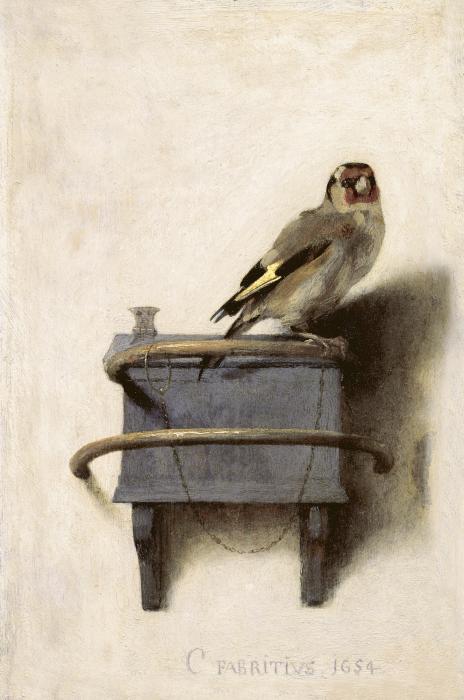
Here it is: Fabritius’ goldfinch. Funny. After reading this book twice now, I imagined that the picture would have a eerie kind of bioluminescence–a living glow that would flow through the rectangle in Google images, bounce around some rods and cones and register in my brain as a masterpiece so bright these mortal eyes should be averted. (Also, was I wrong to think the goldfinch would be bright yellow?)

But maybe the reason it doesn’t have that effect was because Google handed me a screen that looked like this:

Capture

Professional deep thinker Walter Benjamin wrote a rather dense piece called “The Work of Art in the Age of Mechanical Reproduction” in the 1930s. It explores the role of art in an era capable of producing film, photography, and — most interestingly (to me) — machine copies. He posited that a work of art has an aura, and that that aura is based in its uniqueness. Therefore, every time a student puts up a poster of The Persistence of Memory in their dorm or every time someone sips coffee out of a mug imprinted with Monet’s lilies, the original’s aura is depleted.

Benjamin isn’t saying this is necessarily bad, and there’s a lot more to the essay — most of which I’m too obtuse to really wrap my head around, even after reading it several times. But seeing all these reproductions on my computer screen…is that what takes the magic out of the painting? Not according to Tartt’s The Goldfinch.

I was struck by how many twists on Benjamin’s essay come rolling in at the end of The Goldfinch (novel). When Theo is in the Netherlands, escaping from the scene of a heist-on-heist, he knows that the painting is authentic the moment he looks at it during the car ride to Amsterdam. It glows with an ethereal light he knows so well. The entire book seems to imply that The Goldfinch (painting) has a soul inside it, defying all of Benjamin’s claims that a painting’s aura is depleted in an age of mechanical reproduction. Surely the painting has been photographed thousands of times, as indicated by my Google image search. In Tartt’s book, Theo sees reproductions of the painting in art books, newspapers, and even a photograph of Welty in a room with a counterfeit. (Which, by the way, is an image of an image of an image of an image. The last image is the bird itself. Intense.)  Yet the soul of the thing doesn’t seem the least bit damaged by all its reproductions, at least not to Theo.

Even the painting is a reproduction, as Theo knows. He has no doubt that the artist had a live subject, and Boris mentions his certainty that, in a cage full of goldfinches, he could point out with ease the goldfinch. Theo and Boris both seem to believe that they know the bird, as presumably do the many others bewitched by the painting: Welty, Theo’s mother, Lucius Reeve. And yet, at the end, Theo comments that the painting is a trick, a “joke” — these globs of paint and scratches into the canvas and brushstrokes that, as you stand back, transform from what is really just deposited paint into a very convincing representation of a bird. One might point to the painting and say, “It’s a bird,” though really all the viewer is seeing is patterns of paint.

How can this reproduction not be a thing that takes from the soul of the bird? How can the painting have a aura its own, if Benjamin is correct?

Theo even sees the glow of the painting in a forgery, placed on a wall in an old photograph of Welty as a child. It’s difficult to get further away from the original goldfinch (or original goldfinch painting, even) than this image four times removed. But Hobie, the book’s good-hearted creator of forgeries that he never intends to sell, has an answer for Theo. He guesses that it isn’t the originality or uniqueness of art, as Benjamin suggests, that gives art its aura. It’s the beauty of line. If there is a particularly beautiful shape, it doesn’t matter if the object is reproduced or original. That’s why his lovingly created reproductions of antique furniture were so charming — he was reproducing a thing that had beauty, and he was able to preserve the thing that made it beautiful. It seems that Hobie doesn’t buy into Benjamin’s theory at all. But both believe that the original goldfinch painting in itself would lack the mystic quality Theo assigns it.

If Hobie or Benjamin speak true on the subject of the original piece of art lacking a soul–in Hobie’s mind, because it’s the beautiful image of the goldfinch, not the object that is the painting, that’s important; in Benjamin’s mind, because the painting has been reproduced enough to have had its soul depleted)–why is it that Theo so passionately felt that if The Goldfinch (the painting) was destroyed, the world would have lost something important? Why was it so necessary that what he held in his hand was the real thing on the way back to hotel in Amsterdam? I don’t have an answer for this, and I certainly don’t think the novel does, either. And, on another subject, that might be one of my few complaints about the book.

I connect so wholeheartedly to this novel. Just about every page of The Goldfinch absorbs me fully. But there is a lot of incoherence in it. That’d normally be fine with me; life is rather incoherent. But it seemed so important to Tartt, especially at the end, to become some sort of lecturer/philosopher. You have to have a special kind of brain for that. A Walter Benjamin brain. One capable of working out a theory, however crazy, to a certain level of completeness. A brain that can reach beyond bland platitudes and reach a hypothesis that, for instance, isn’t so broad that it can’t be wrong. Tartt is a glorious, deep feeling, intelligent author, but she doesn’t have that brain.

The end of The Goldfinch could have saved if Tartt stayed in-novel. The parts where Boris and Hobie sit down and start talking about “You know, maybe bad deeds can result in something good” is pretty cheesy in a folksy, from-the-mouths-of babes, “Well, little ‘ol me don’t know much about ____, but I’s been thinking…” type of way. But it was tolerable. The whole meta-lecture from Theo at the end, on the other hand, (which goes on for pages and pages) is insufferable. I just went tearing through it the first time, since it was two in the morning and I could see I was close to finished. But this time I sat through every word, focused. It isn’t horrible writing, but it’s patronizing, and it takes you waaaaaay out of the novel to treat you to some “big thought,” stoner ending. The end of the book meant well–it meant to bring us closure after all these pages filled with Theo’s ongoing, unspeakable sadness. But it was reminiscent of–horror of all horrors–John Galt’s speech (a.k.a. Ayn Rand’s excuse to bluster incoherently about her personal world view for a sickening number of pages) in Atlas Shrugged.

Ending aside, I remain firm after my second reading.  The Goldfinch is a spectacular book, full of aching feelings and beautiful intricacies. It contains endless starting points for conversation with others, but it will at the same time be a deeply personal experience for the reader to have. It brought to my mind many philosophies of which I’ve read–not just those of Benjamin, but also those of aesthetes and critics from many fields and varied time periods. It’s a great introduction to ways of thinking about art. as well as to good literature.

Theo’s Spiritual Connection to Objects in The Goldfinch

To lift one of my favorite introductions (Simon Jarvis, from an essay in PMLA), “Reader! No time for pleasantries!”

It’s easy to assume Theo is attached to the goldfinch painting because it’s his last connection to his mother. And that may be so. But I think there’s more there.

I’m really struggling for a word here–totemism comes to mind, but it’s not exactly right. It might do for our purposes here though, if you’ll allow for some flexibility. Totems are symbols of one’s spiritual connections to things of the earth. The term is mostly used in reference to animals. But here, Theo connects to manmade objects the way tribes have connected to a specific creature or element. His goldfinch painting is the most obvious example–and it isn’t the animal he connects with as much as it is the painting. He feels differently with it around, looking at it, holding it. He obsesses over the weight and feel of it, and he feels as if it glows in a way that’s almost unearthly. But he does this with other things, too, starting from a very young age. About Welty’s ring, he says this:

For reasons I would have found hard to explain, I had taken to carrying the old man’s ring with me almost everywhere I went. Mostly I toyed around with it while it was in my jacket pocket…I ignored [Mrs. Barbor’s] advice to put it in a safe place, and continued to carry it around in my pocket. When I hefted it in my palm, it was very heavy; if I closed my fingers around it, the gold got warm from the heat of my hand but the carved stone stayed cool. Its weighty, antiquated quality, its mixture of sobriety and brightness, were strangely comforting; if I fixed my attention on it intensely enough, it had a strange power to anchor me in my drifting state and shut out the world around me…

And Theo, especially after his trauma, continues to find objects, not people, his anchor. He feels utterly lost when he realizes he no longer has access to his painting. He immerses himself in the touch and feel of the furniture he works on with Hobie. Certainly he finds solace in a few people here and there, but what he finds the deepest connections with are not people, but things.

There is one exception. The way he describes Pippa in the book is very similar to the way he describes the objects he attaches to. He notes her attributes, like her hair and clothing, with the same sort of fetishism with which he describes his totems. I wouldn’t probably go as far as to say Theo sees her as an object. In fact, I think part of what draws him to Pippa is the fact that he cannot possess her like he can an object. Theo’s a deep-feeling, intensely spiritual person, even from childhood, so it makes sense that he doesn’t objectify people quite in the context that we’d usually use the term.

He does not always know why he experiences the attachments he does–he just records his feelings and leaves them unsorted and unanalysed. I find it understandable, this reluctance to wonder too hard about the reasons behind his emotions. I don’t quite think of him as psychologically insightful, but that’s one of the great things about this character and about the book. It allows the reader to do the psychological work.

Theo in some ways reminds me of a character from a book I haven’t read in a long time: Joyce’s A Portrait of the Artist as a Young Man. Theo is an aesthetician (an old-school one, not the kind you find at the Clinique counter), but there’s a desperate quality to his appreciation of beauty. When he learns that people can be lost, he connects instead with objects. Then, when he realizes objects can also be lost even when the greatest care is taken to preserve them, well, that’s pretty rough.

The Goldfinch: Also…

There are a lot of negative reviews of The Goldfinch out there from those who find contrarian delights in raging against the literary machine. There are accusations of juvenility and uninventive language. Props to them for their reluctance to accept a well-acclaimed book simply because it is well-acclaimed, but in this case, they’re just bitter. The book makes us take a juvenile seriously, and any moments of cliche (“tip of the iceberg,” for example) add an element of conversation and authenticity.

Take this as a clearly biased report from Camp Goldfinch. “Think for yourself; question authority,” as the great band Tool advises, but read the book. You’ll decide.

Here is a much better synopsis than my own from the New York TImes‘ Book Review.

The Goldfinch: All it’s Cracked Up to Be

As a loud and proud feminist, this is the worst thing I will ever say. (Yes, leave it to me to think of the worst thing I will ever say and then immediately put it on the internet.) I finished The Goldfinch before even looking to see who the author was, and I was shocked to learn it was written by a female.

I had a discussion with a very forward-thinking teacher once about why I don’t like female writers as much as male ones, historically. He, too, very much resented himself for feeling like male authors seemed to create more depth in their work. But, as ashamed as it made us, it just seemed true. There are glowing exceptions, of course (Eliot, Chopin, the Brontes), but even they seemed to have heteronormative-relationship-driven plots, with romance being at least one of the major (if not the) key theme. In fact, I think this is why I resented Anna Karenina. It seemed to me a very “female author” book–all about man-woman pairings and dynamics. I think about Whitman’s claim that he contained multitudes, and it seems to be the anti-anthem of the novelists I don’t like (who, unfortunately, often tend to be women). “I contain the potential for romance” seems to be the driving force behind it all.

We have been and are entering a new era of women writers. I don’t know why, after reading books from Jennifer Egan and Toni Morrison, I still have lower expectations. But The Goldfinch solidifies it. This is a deep and rich book that explores so many facets of human existence, with an absolutely riveting plot the whole way through. It’s multidimensional and complex psychologically while carrying with it a story that captivates. The climax of the book went on forever, and I got four hours of sleep one night because I couldn’t put it down. In fact, this whole enormous book was enrapturing the entire way through. In fact (x 2), the reason I haven’t posted about it yet is because I accidentally started reading the whole thing again. I couldn’t help myself. I wanted to be back in this world of multitudes.

Have you heard anything about the book? There was a lot of hype around it. Let me say, the Pulitzer will not lead you astray here. Every bit of the hype is well-founded. I can’t say enough about how good this book is. It’s the realest, freshest thing I’ve read since…oh…well, since Crime and Punishment. But still…

First off, this book even the sentence level is fresh. You know what’s really hard to do without entering cliche-land? Similes. Try writing a simile that doesn’t sound like bad poetry. Do it, right now. I’ll wait.

It was bad, wasn’t it?

This book is filled with similes that are gorgeous and vibrant and don’t stick out as similes. Here is where I would put examples, but I’ll just make that another post if need be. This sucker’s gonna be long enough.

Second of all, the book paints so many beautiful portraits of people, and it does so by showing, not telling. The main character is a prime example of this.We get to know him so well, and yet we don’t even understand what the goldfinch painting held so dear by the narrator means to him. Not even he knows, really. It just does, for reasons seemingly obvious but that will escape articulation if we try to explain it. Again, deserves an entire post in itself. Every one of the characters is complex and yet understandable, even the bit players like Tom Cable.

Third, author Donna Tartt does the passage of time so amazingly well. There is an “eight years later” jump at one point, but I think it helps character development. All of a sudden, our poor hero is in an unexpected place, and we learn how he got there. It all makes perfect sense, yet it’s surprising. The most amazing example of the passage of time is the way the author explains the development of what winds up being the extremely close friendship between the main character and Boris in Las Vegas. It develops naturally and beautifully. Speaking as someone who has a friendship very much like the one described in the book, the coverage of the time was so natural and the closeness that developed made so much sense. It all rang authentic in my mind. That, like the non-cliched simile, is very, very hard to pull off.

But my main takeaway from this book is that, even though the world of The Goldfinch is a fairly sad one, it’s a place I love to be. It envelops me. It rings true and real and beautiful. It’s heartbreaking without being sentimental, and it’s raw without being dramatic.The Goldfinch doesn’t pull any punches. It’s as complicated and involving as it is without gimmicks.

Clearly, this is a vague overview. I haven’t really said much of anything about the book. This is a real challenge for me to write about because it’s like someone asking me to try to describe my existence on this planet in a blog post. I’d just be left dumbfounded. There’s too much, far too much. The Goldfinch contains multitudes, and all we can hope to do it examine it piece by piece, I think. The whole of it is too far beyond words. That the author created these multitudes in the 700+ pages of this book is an impressive feat in itself. 700 pages wouldn’t be enough for me.

Announcing Pulitzer Adventure

As may be inferred from my lack of posts, I am in a coma. Metaphorically. Well, literally, too, according to the dictionary’s new definition of “literally” (see 2: “virtually”). I feel too drained to even hold a book open these days. I’ve read the first ten pages of Gravity’s Rainbow twice now, and nothing is sticking. I am a mental vegetable. My creativity and motivation are at an all-time low. I suppose the ebb and flow of these things are the nature of life. But not to fear. I am changing.

First, I am going on a diet of pasta, brownies and pizza. After many days filled with iceberg lettuce in lemon juice, I have decided carbs are good for the soul.

Second, I am going to stop trying to read books I’m not in a good state to read, knowing my mental state is constantly in flux. If I can’t read something, it’s just not the right time. I can come back. Once upon a time, I was a bartender. In those days, I could read anything, and I did so with consistent enthusiasm. Nothing was competing with books for my feelings of satisfaction in life (that “career” sure wasn’t), and I was very interested in my own edification. But when you have a job that challenges you, excites you and makes you grow, there’s competition for that edification. Sometimes you’re too tuckered out to come at life with barrels of enthusiasm for twelve hours in a row…especially if you’ve been eating lettuce with lemon juice dressing. I’ve decided it’s okay if I’m going through a period where it’s hard to concentrate, and it’s okay to choose readable, not-as-challenging works. As someone who normally enjoys a challenge, this is hard to accept about myself. But it’s cool.

Third, to reinvigorate the reading life, I have decided to take on a project. I’m going to work through the Pulitzer winners for fiction, starting from 2014’s The Goldfinch and working backwards. I’m always asked to recommend books, but my current list of favorites skew classic and that simply won’t be most peoples’ bag. I know that sounds like sneaky-bragging, but I swear I have no pride in the fact. It’s just circumstance. The cheapest books are the classics, so I’ve been reading them since I was young. Unfamiliar language can be a real hangup, and the language of most pre-1900s books is not unfamiliar to me. So just as a kid who grew up speaking two languages wouldn’t brag about fluency, I wouldn’t brag about being more used to ye olde-style speak. I know most people aren’t used to it, and I know just as well that it makes for hard reading. For instance, the language of Pynchon is flow-y and streaming and often hard to follow, and that’s unfamiliar to me. It’s work. And I, like anyone else (especially those who are in periods of exhaustion) am far less likely to read it if I’m too tired to work.

Furthermore, you should be suspicious of anyone who acts like the classics are superior to modern literature. All books were contemporary once. Some books written in the last 10 years will become classics one day. The interesting thing is finding them in a world teeming with written content. But people are people, whether it’s 2014 or 1714. Some are brilliant writers, some are not. It doesn’t matter what year it is, and be wary of anyone who speaks in definitive terms about the superiority of one era over another and especially of anyone who waxes nostalgic for the good ol’ days of literature.

That’s why I think my Pulitzer adventure will be a great introduction to modern works that will be wonderful common ground for me and others who don’t want reading to be, well, work. There are bound to be books on this list that will be brilliant and told in a way that’s more like our spoken English today than earlier works. I’m looking forward to getting a better understanding of contemporary literature, and I’m looking forward to reading things that neither I nor those that I talk to would consider “work.” And any books on the list I find difficult, well, I’m going to give myself the permission to put them down and move on. Not forever. I’m just willing to wait for a time I’m in a better mindset to tackle them.

Spoiler Alert: Dostoyevsky’s Poor Folk is About Poor Folks Who Talk About Being Poor

But cookie cutter poor folk they are not. They are well-spoken and complex. Nonetheless, this book has been a snoozefest. And you know how I feel about Dostoyevsky. (If you don’t know, refer to a series of posts celebrating every single moment of Crime and Punishment. Beware: it’s literary fangirling to the extreme.)

So here’s Poor Folk. Pen pals/distant cousins Makar Dievushkin and Barbara Dobroselova are involved an awkwardly one-sided May-December relationship.  December’s Dievushkin constantly sends his love to May’s Dobroselova–but not like that, he emphasizes. He loves her like a daughter. A sexy, sexy daughter. Have some bon bons! (This is paraphrased, clearly–I don’t possess anything like the powers of lyrical and subtle prose of my beloved Dostoyevsky. Speaking of which, Dostoyevsky and I are involved in the ultimate May-December unrequited romance. In this case, it’s May that loves, and December died 100 years before May was born.)

I have to be honest. I’m not really in a good position to give this book the same kind of analysis I’ve given many others because I’ve been in skim mode since about 50% in. The writing is beautiful, so I’ve just been kind of soaking it in without processing much of the message. It strikes me as kind of a shame because it seems like this book meant so much when it was published. It was well-received, and it was considered a much-needed, sensitive, humanistic look at poverty. The author of the blog “Read, Write, Now” (who does a much better job of explaining this book that I do here, including why it’s second-tier Dostoyevsky) says, “Dostoevsky gives “Poor Folk” the human dignity to participate in the process of their own damnation.” I see that, but only after it was pointed out to me. I just can’t find much value on my own. Perhaps I’m just not in the right state of mind.

Or maybe it’s because I find both the characters annoying as all get out, and the plot (with the exception of the mini-autobiography recounting Dobroselova’s teenage years) is…well, there isn’t really one. There’s just the same message back and forth. I love you. I’m so poor. But it’s not so bad. But, man, I’m poor. I would do anything for you. I would give my last penny for you. In fact, here’s my last penny. Don’t feel guilty about that, though. Did I mention I’m really poor? But don’t worry, it’s not so bad. Actually, it’s terrible.

ad infinitum.

It’s my opinion that both of these people are codependent and manipulative. And I can only read the same codependent and manipulative message over and over before I zone out. There has to be more movement, more character development than this for me to stay engaged.

I hear echoes of the beauty of Crime and Punishment and Notes from the Underground  in Poor Folk. There is the psychological element, and clearly there is the frank, empathetic portrayal of suffering I find so compelling underneath the sentences I’m reading. But it’s buried too deep under endless, lovely-but-repetitive words. The rawness of later works goes missing in this first one.

I’m sorry, Dostoyevsky. I’m sorry, my love. But I don’t think I can finish this one. But don’t feel bad. Well, feel kind of bad. And have some bon bons.

Writing to Read and Reading to Write

This is a bit off the beaten path, but it has to do with a recently-published article that addresses the way I read in a curious way.

Allow me to preface. I was an English tutor for years. My golden years of tutoring were spent at my college’s writing center, where structured training gave me wonderful, concrete tools that I still use to this day in my job as an editor.

My favorite technique was one I felt not only helped the students I guided but also helped me as I wrote my own essays.  It’s a skill worth cultivating, and it’s simply this: learn how to read as a reader, not as an author.

It’s a bit infantilizing to ask writers to role play, I know. But you can’t imagine how revelatory it is as a college student to pick up an essay you wrote and think to yourself, “I am now my teacher, reading this essay for the first time.” All of a sudden, reading as your audience, you see that things you thought were implied don’t seem clear at all. The point of the essay isn’t obvious. Quotes from other sources are dropped into the text in ways that leave you thinking, “wait, what does your quoted material have to do with what you were just saying a sentence ago?” When you take some time away from your writing (enough time to help you forget your own train of thought as you wrote), distance yourself from your perspective as author, and consciously try to place yourself in the position a first-time reader, you can eliminate a great deal of spots where your writing is unclear.

My experience doing this role playing concerns expository writing–either I’d be doing it with my own essays or helping students do it with theirs. I write and edit mostly presentations of arguments, analyses, and explanations, both at work and in my spare time. Creative writing has never been my forte, and I don’t often write more than one or two creative pieces a year. Yet my greatest recreational delight, as you can probably gather from this blog, comes from reading creative work.

I love knowledge, but I need the information to be beamed into my head via laser or something. Reading nonfiction absolutely puts me to sleep. Even the things I’m most interested in–history, biography, natural science, cars, and yes, even grammar and language–can only command my total focus for a few minutes when presented in book form. I read almost solely fiction because I adore stories, characters, symbols, experiences. I can’t create it myself for the life of me. But I love to enjoy others’ work.

An article called “The 10 Commandments of Reading Like a Writer” showed up in my Twitter feed the other day. Because its wording so closely mirrors (yet puts a twist on) my mantra of “read your writing like a reader,” I was intrigued. And I found that, though I’m not at all a creative writer, many of the things the article’s author lists are exactly the things I do when I read. It’s why many of my blog posts even exist.

The author, K.M. Weiland, first says that you should be able to see both the good and the bad in the authors writing and, instead of focusing on it, learn from it. I’m often very much aware of an author’s technique, and I’m often thinking of where it’s going wrong and right. I’m lucky that I’m able to be caught up in a story while understanding there’s a real person who’s penned the thing, composing every word and orchestrating every turn. Paying attention to these things things doesn’t detach me from a novel, and in that sense, I think I’m pretty blessed. But my ultimate goal isn’t to write myself–it’s to understand what I like about writers and help me know why I think what I read is good or bad.

The article’s author also encourages her reader to take in works that are superior to what you produce, saying “Absorb them like a sponge. Figure out how they tick. Supposedly we’re each an aggregate of the ten people with whom we spend the most time. Same goes for the authors we read.” Funny–I should be a better creative writer from all my reading, shouldn’t I? I spend way more time with great authors than I do actual people. But I know what she’s saying. I love becoming acquainted with a really great author and taking in all their techniques. I love experiencing something and then trying to figure out how he or she did that–made me feel the way I felt, react the way I react. In a lot of ways, I feel it’s like watching a magic trick and allowing myself to be totally astonished. Then I learn how the trick is done. But seeing the trick isn’t ruined for me once the secret is revealed; rather, it’s enhanced when I watch someone with great skill do it so smoothly and with such finesse that I’m still enraptured. And awareness I would never have the grace to pull off the same maneuvers only enhances the experience.

The author of the article suggests to mark up your books like crazy, which I also do. Anyone who’s ever let into either my personal book stash or Kindle will see an abundance of observations, connections, and (in books with which I’ve had bones to pick) obscenely-worded tirades that would make the squeamish blush. I revere the skills of the author, but I never have been the type to see books themselves as sacred objects. They are alive and meant for interaction. Writing all over books is how I interact. I image this may result in problems one day–I might skew a future reading by prejudicing myself toward old interpretations just by their presence in the margins when I’d otherwise be open to a new interpretation. But if I find this happening, I just buy a new copy. The glory of the Gutenberg is that books aren’t sacred. They’re a dime a dozen (literally so, at garage sales and your library book sales).

But the article’s reading-as-writer point I liked best and related to most is the “study specific topics” suggestion. Here, she suggests doing what I do to particularly riveting songs–dissecting them piece by piece.

If I find a song a really like and that I also think is complex, I like to go through the track several times, once focusing only on the bass line, once only on rhythm guitar, once only on drums, etc., until I’ve figured out how every piece fits together. Weiland suggests doing a similar thing in her “reading to write” article, specifically “studying narrative, dialogue, character arcs, or foreshadowing.” It’s not often I’ll actually go through and read a book over and over, once looking at character arcs, once examining foreshadowing, etc., but I do try very hard to pay attention to how all these the instruments come together to make a symphony. And I think you can only do that if you’re cognizant of all the parts.

Anyway, I thought it was very interesting that I, without ever having any hopes (or illusions) of becoming a novel-writer, accidentally practice all the reading techniques she suggests for becoming a better novel-writer. I wonder if it’s from all that advocating for role playing in my college’s writing center. The reverse of reading your own writing as if you were the audience is to actually be the intended audience and try to understand the author. And I very much love to use a book to pick the author’s brain. It allows me to enjoy what I read so much more and appreciate a talent I simply don’t have.